Multiple Vocabulary Facility Avatar
  1. OMG Specification

Multiple Vocabulary Facility — All Issues

  • Acronym: MVF
  • Issues Count: 21
  • Description: All Issues
Closed All
All Issues

Issues Summary

Key Issue Reported Fixed Disposition Status
MVF11-17 Having both a vocabulary entry and abbreviation class is redundant MVF 1.0b1 MVF 1.1b1 Resolved closed
MVF11-16 Definitions for a number of core properties are missing from the metamodel section of the MVF specification MVF 1.0 MVF 1.1b1 Resolved closed
MVF11-35 Update the informative 'load' file for MVF to incorporate latest metadata MVF 1.0 MVF 1.1b1 Resolved closed
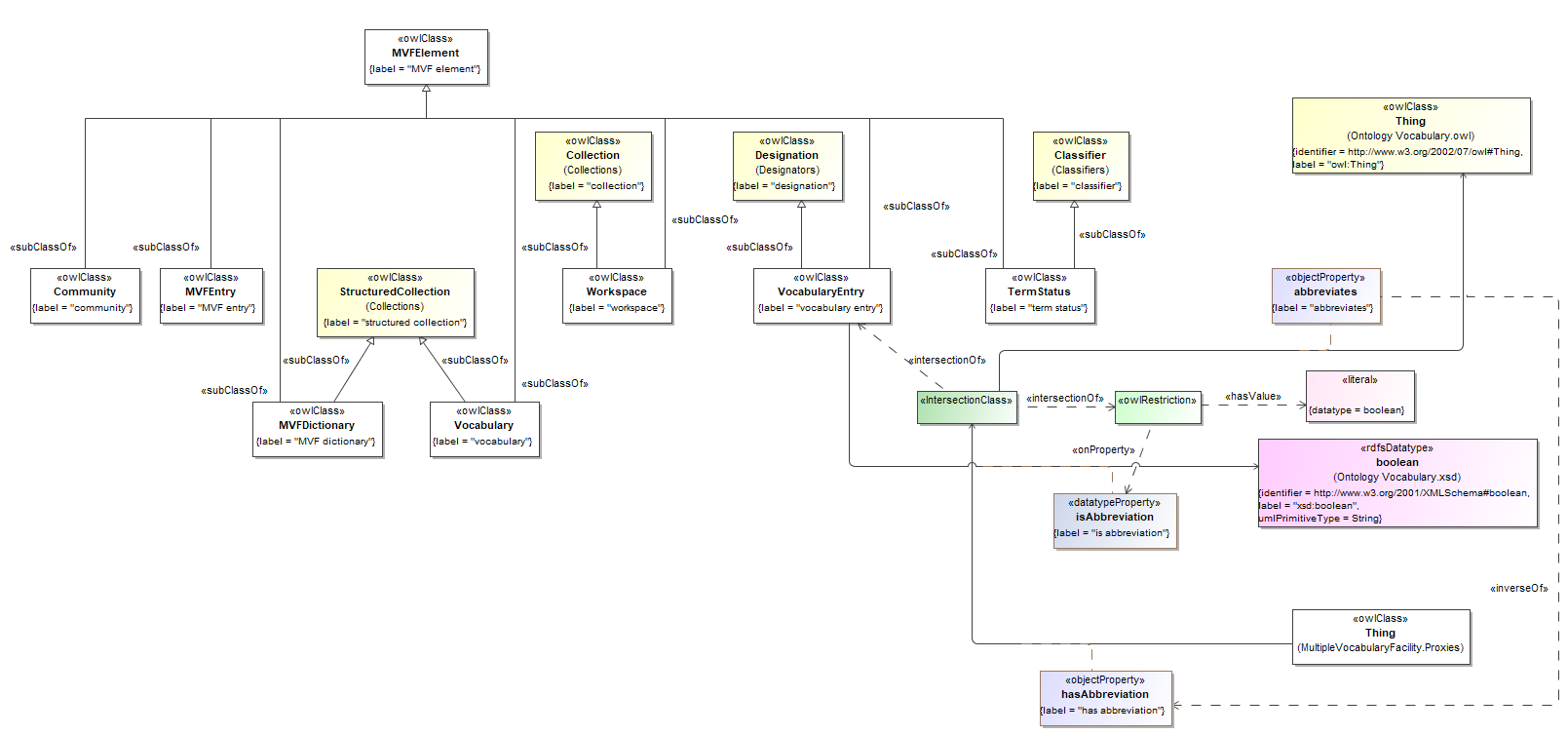
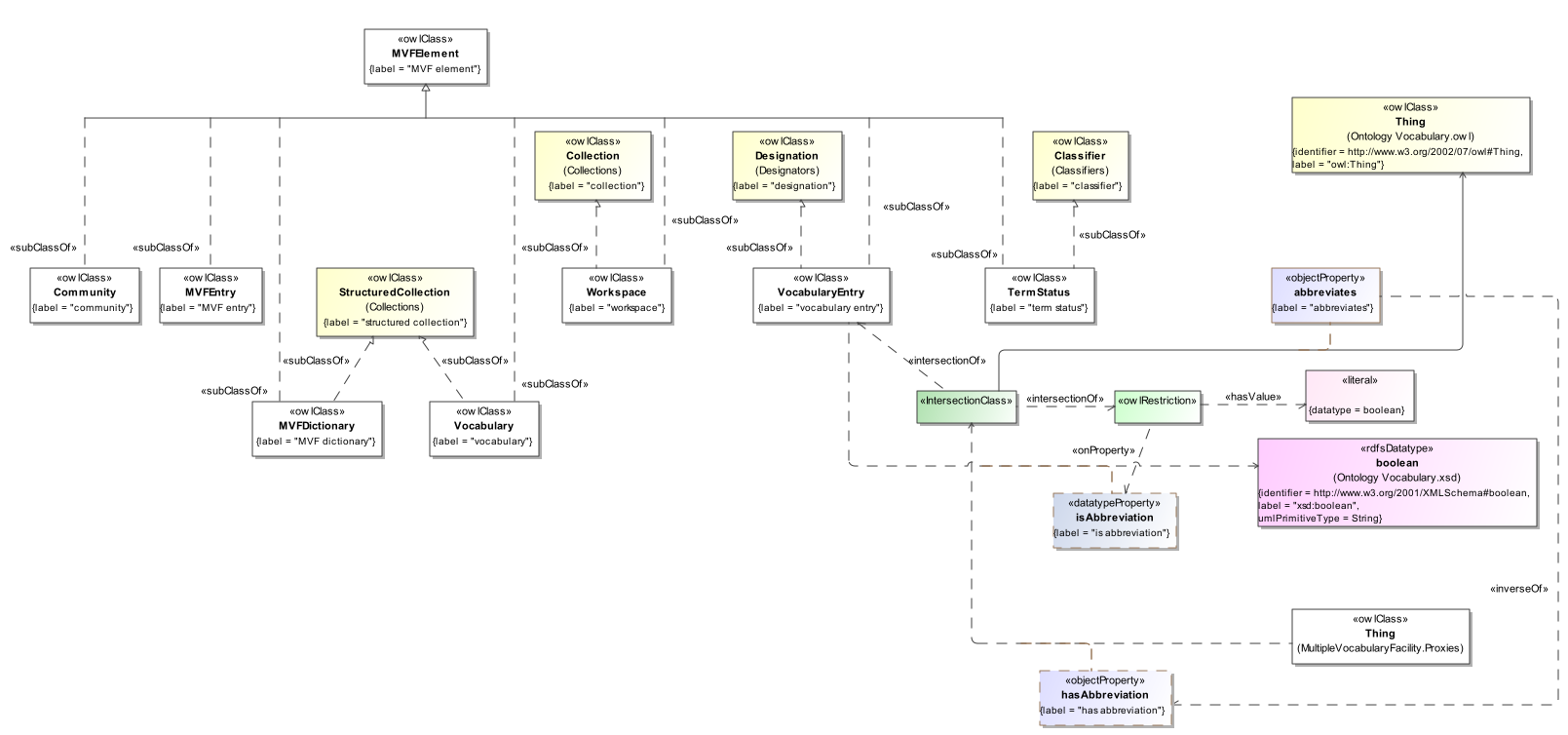
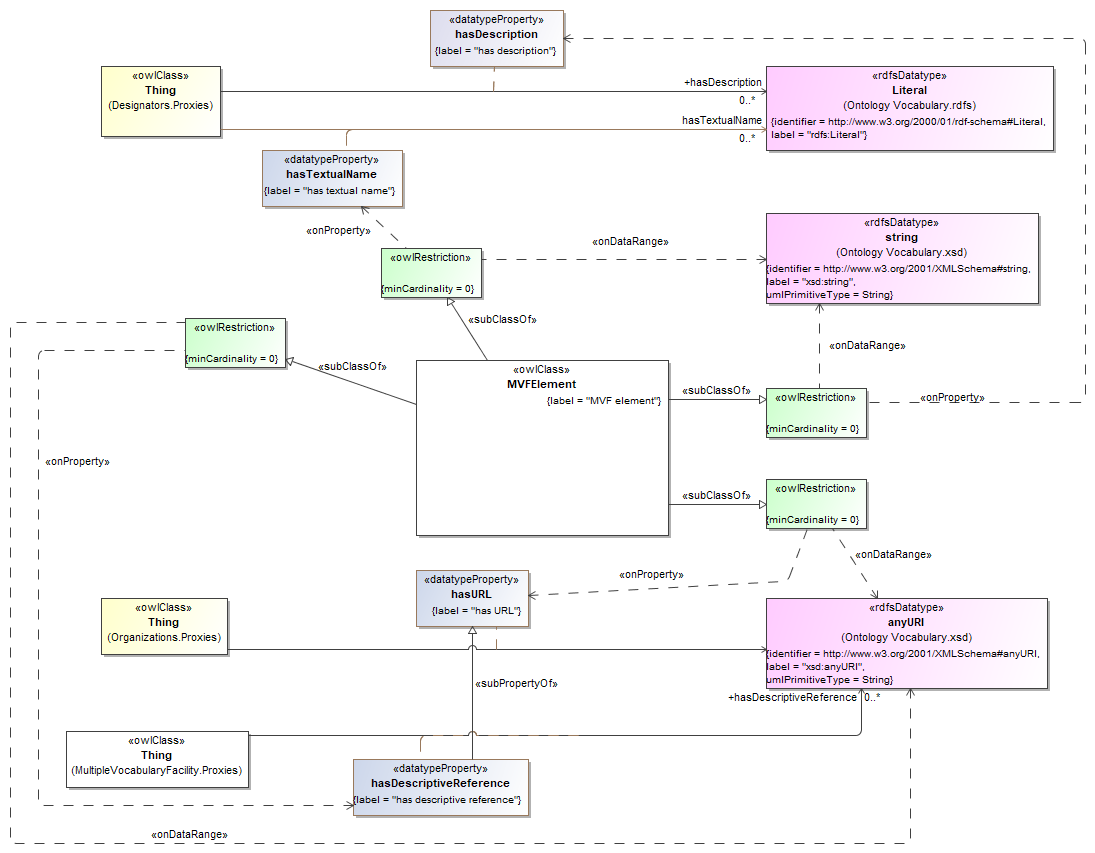
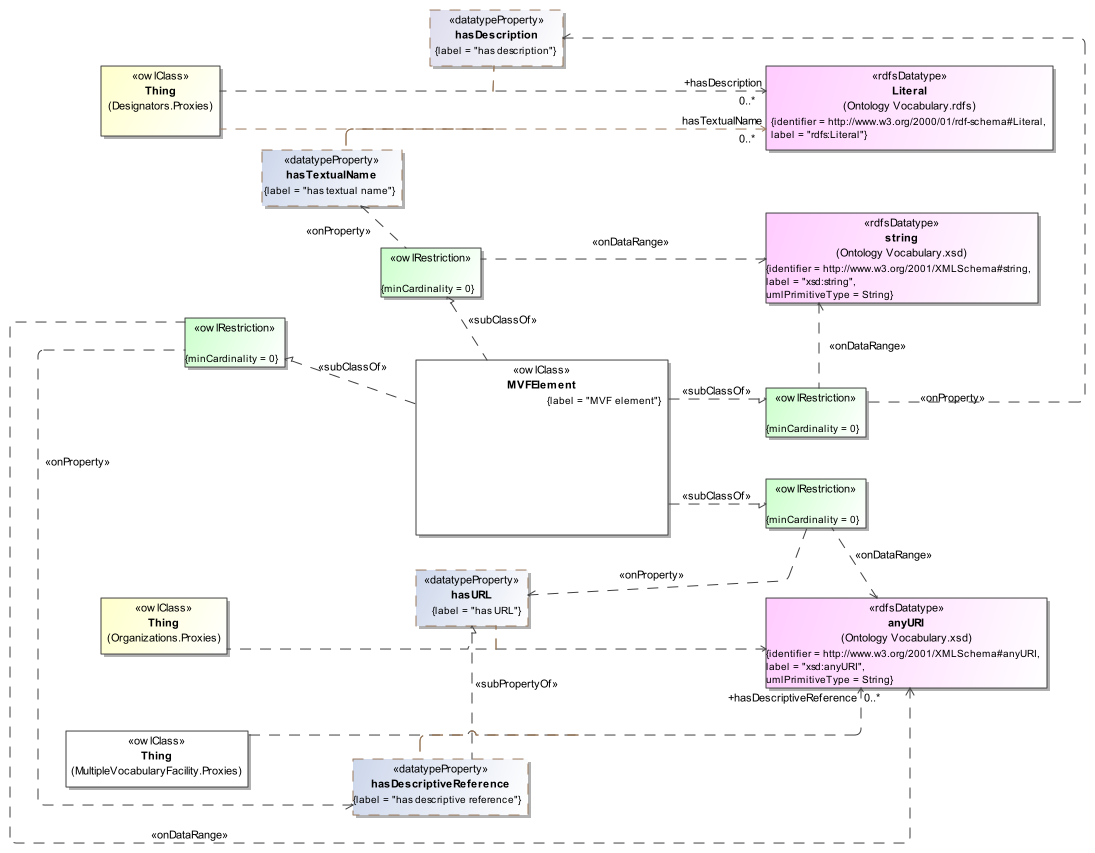
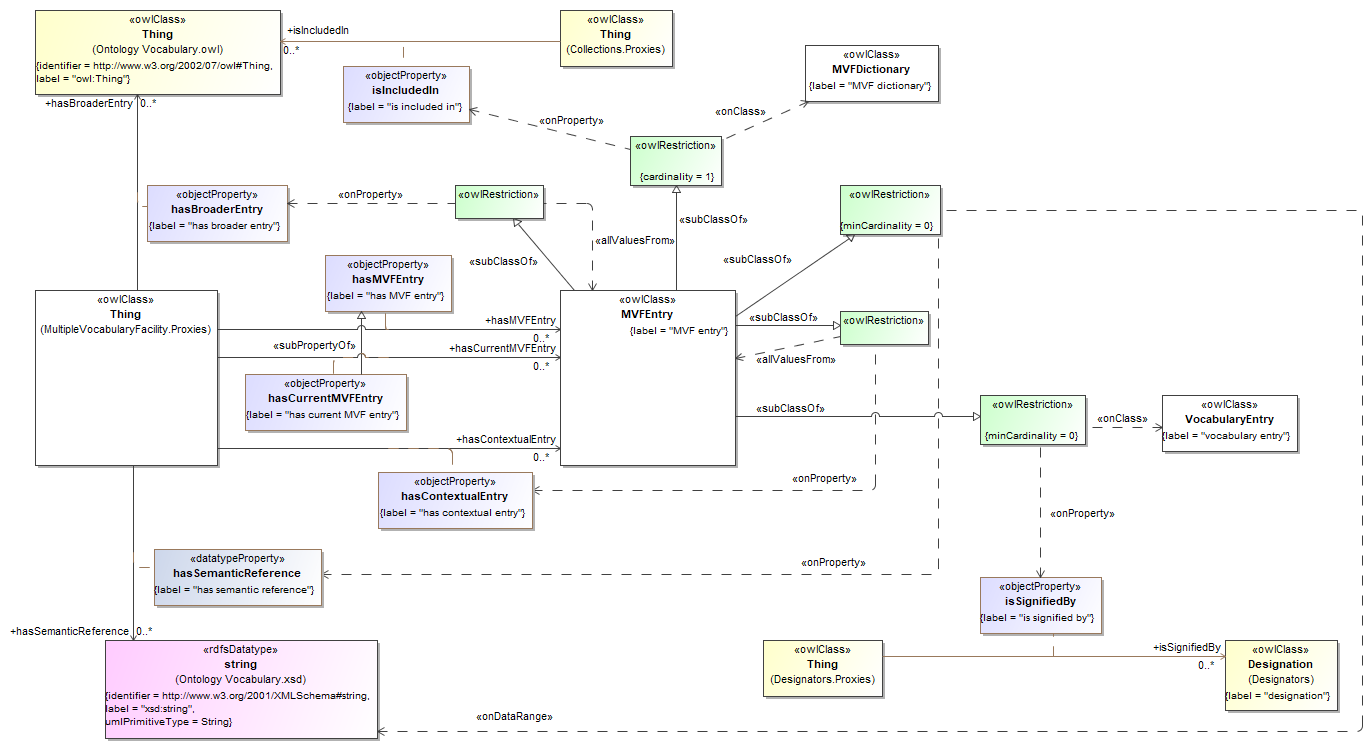
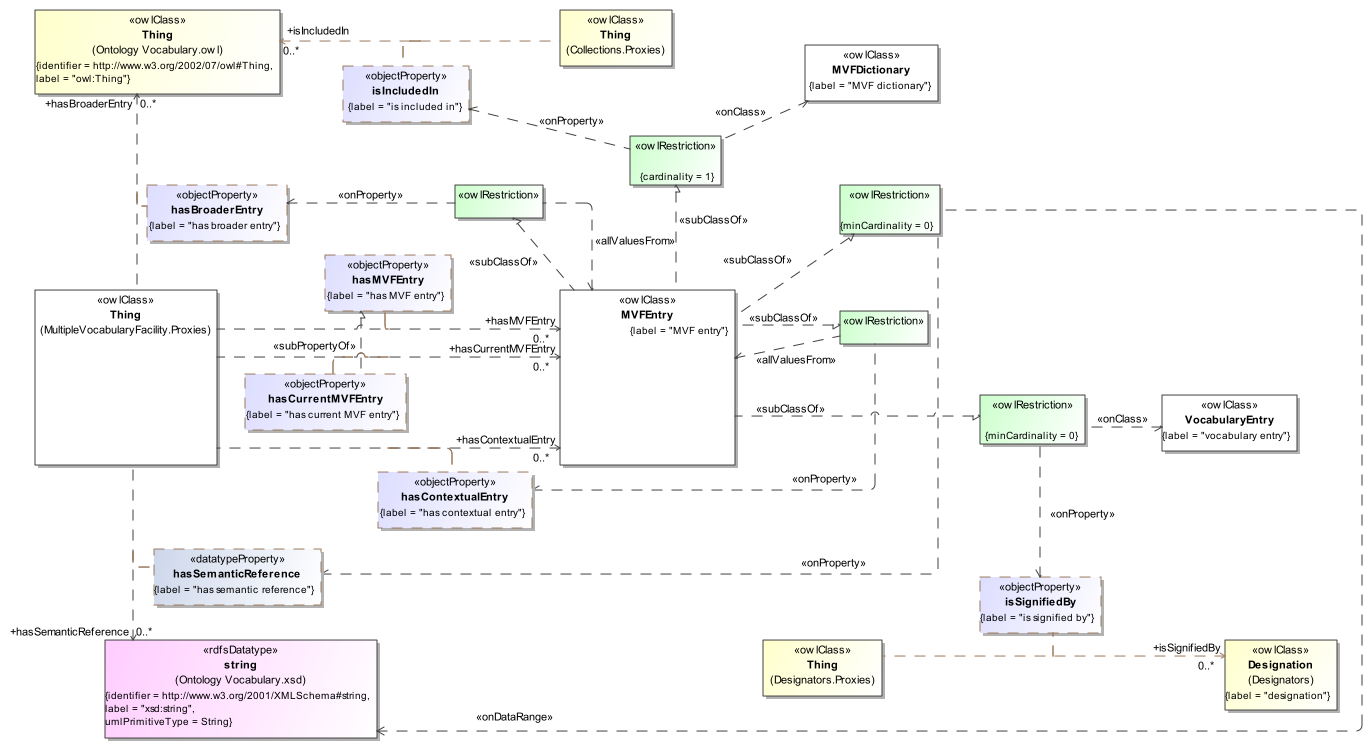
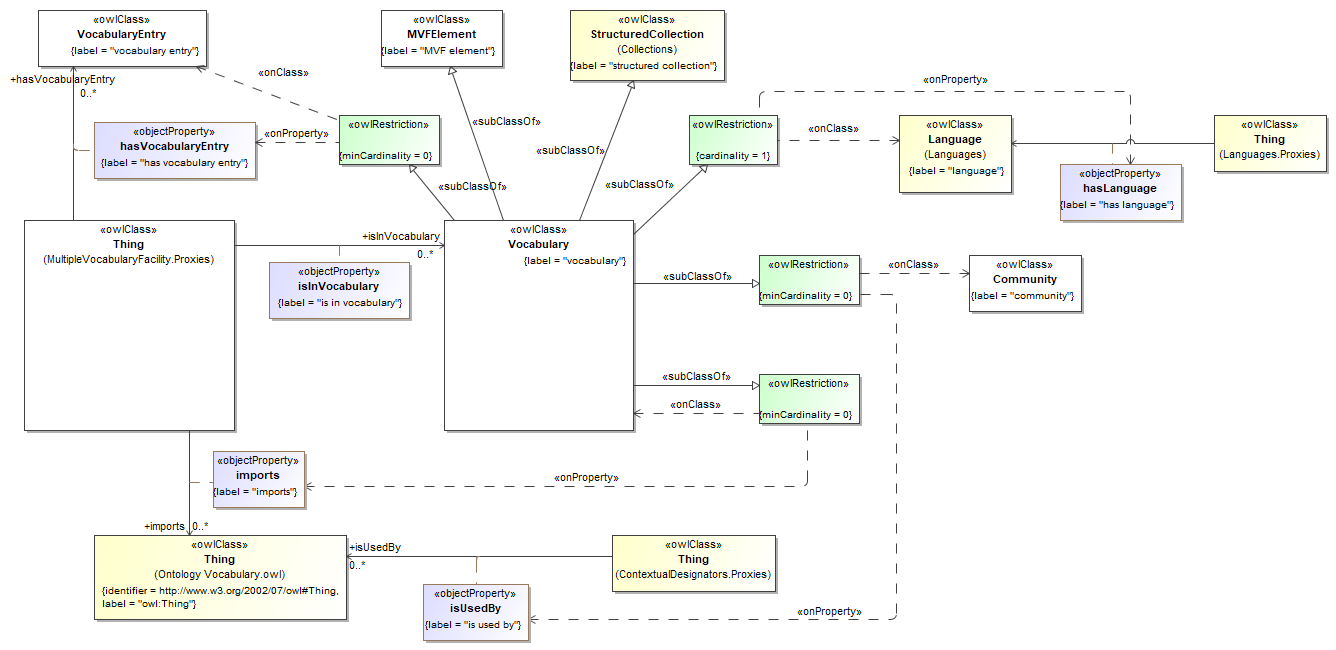
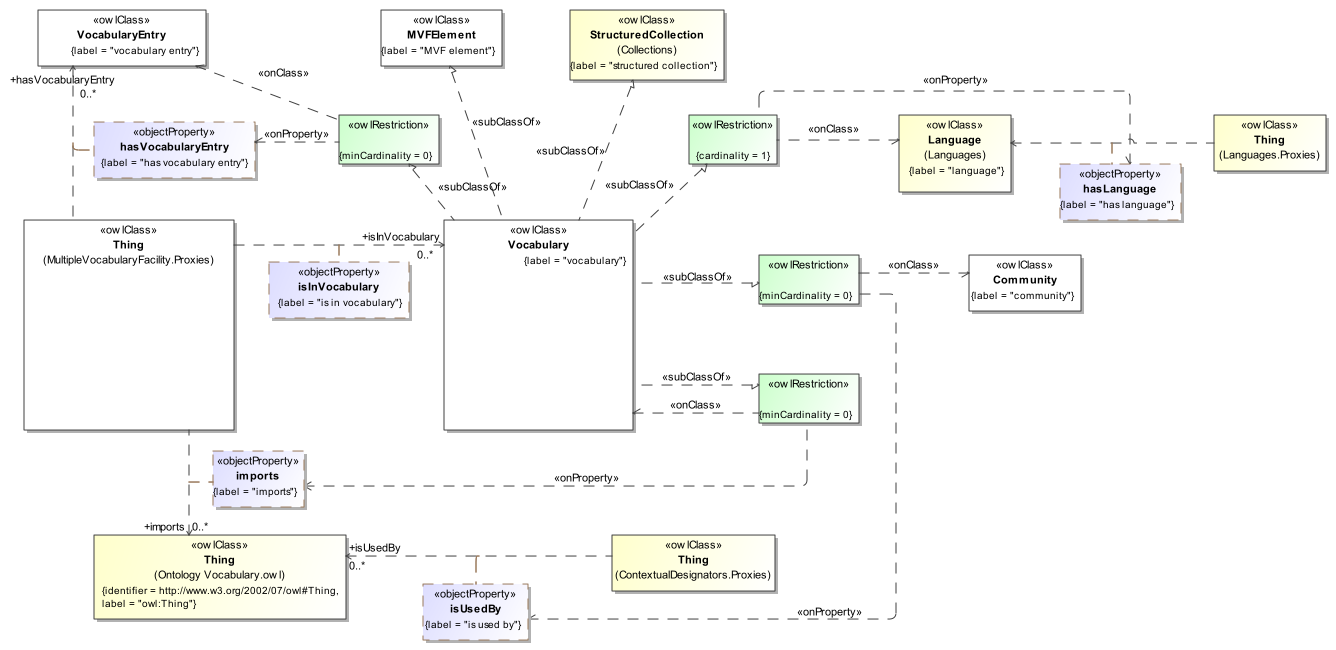
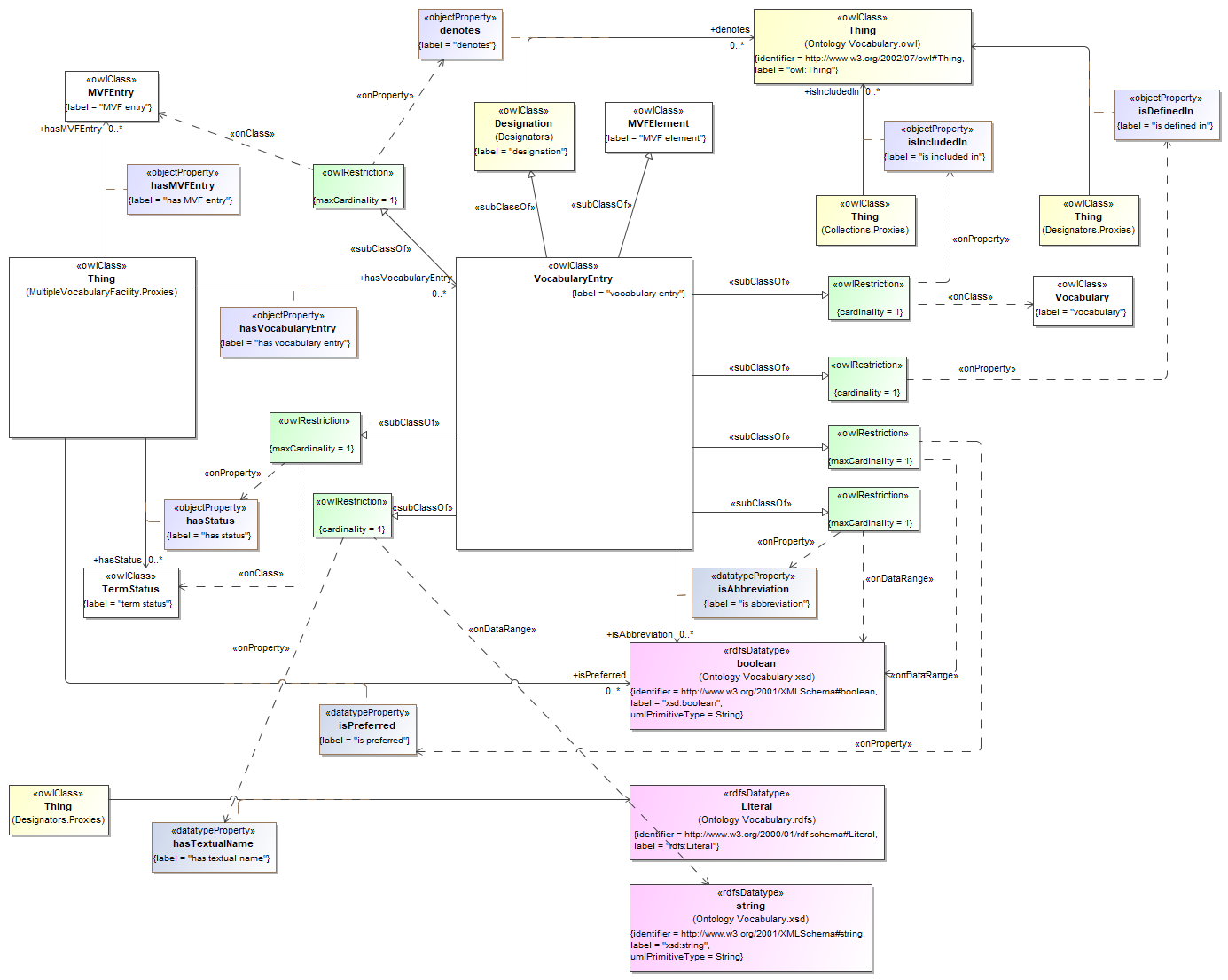
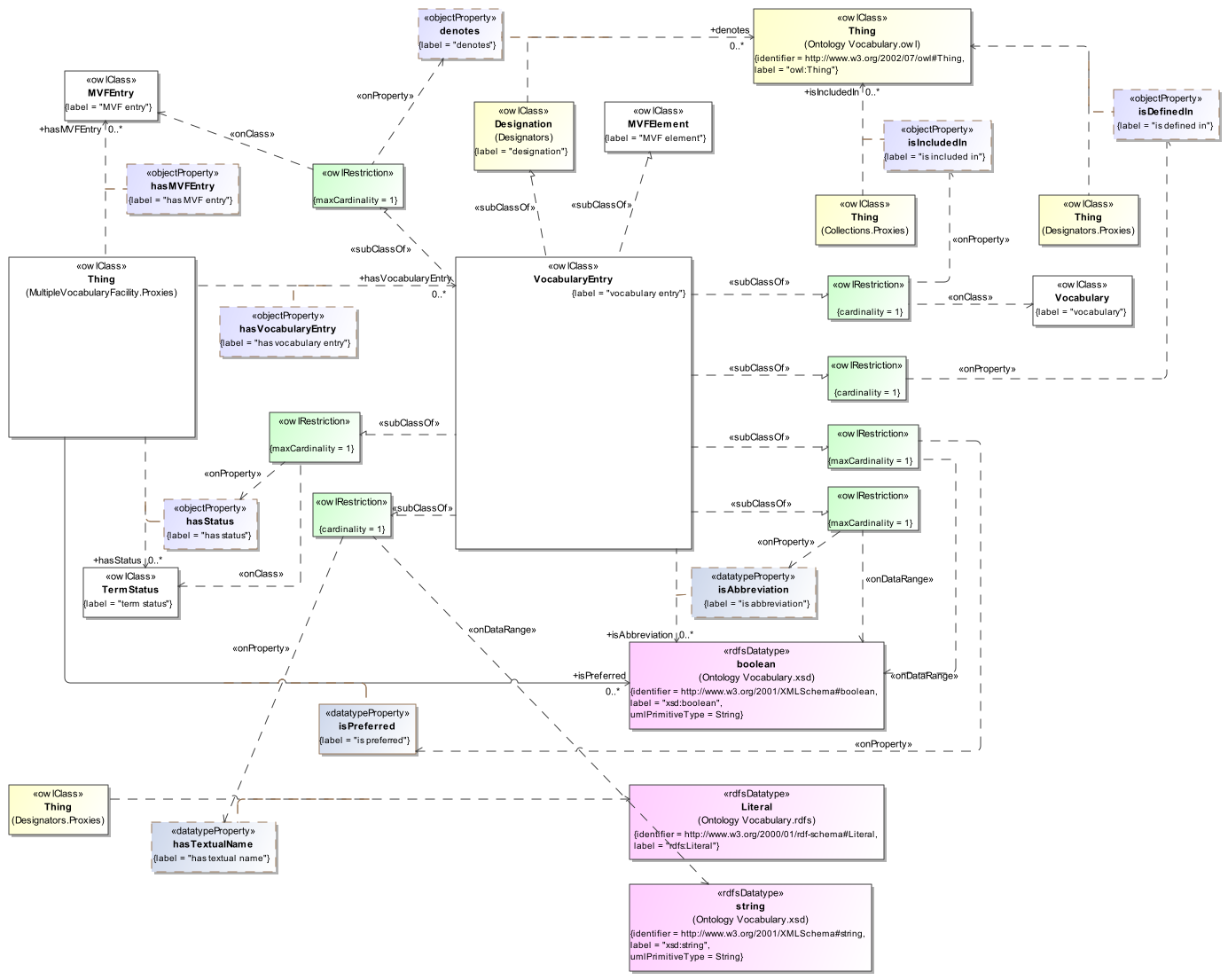
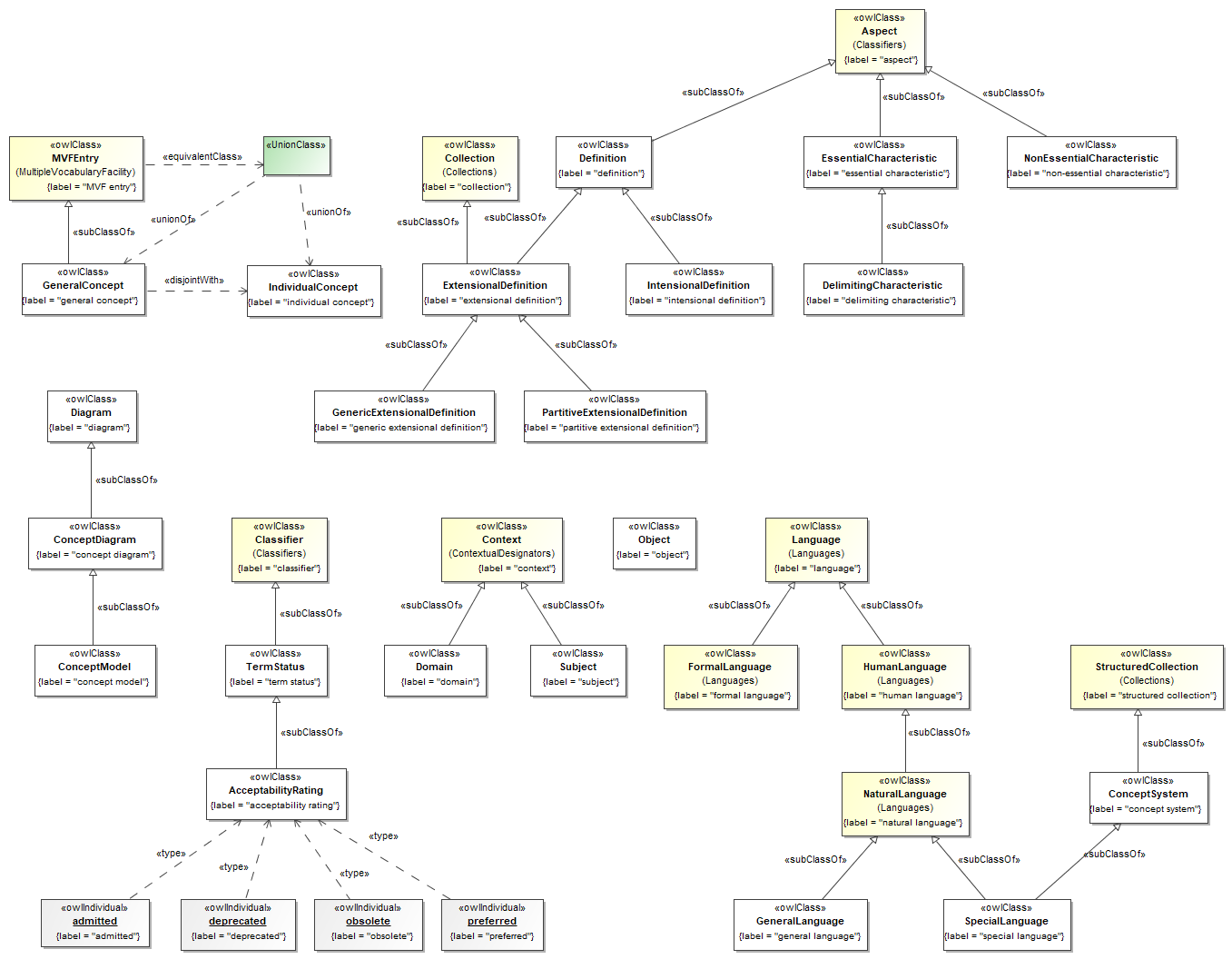
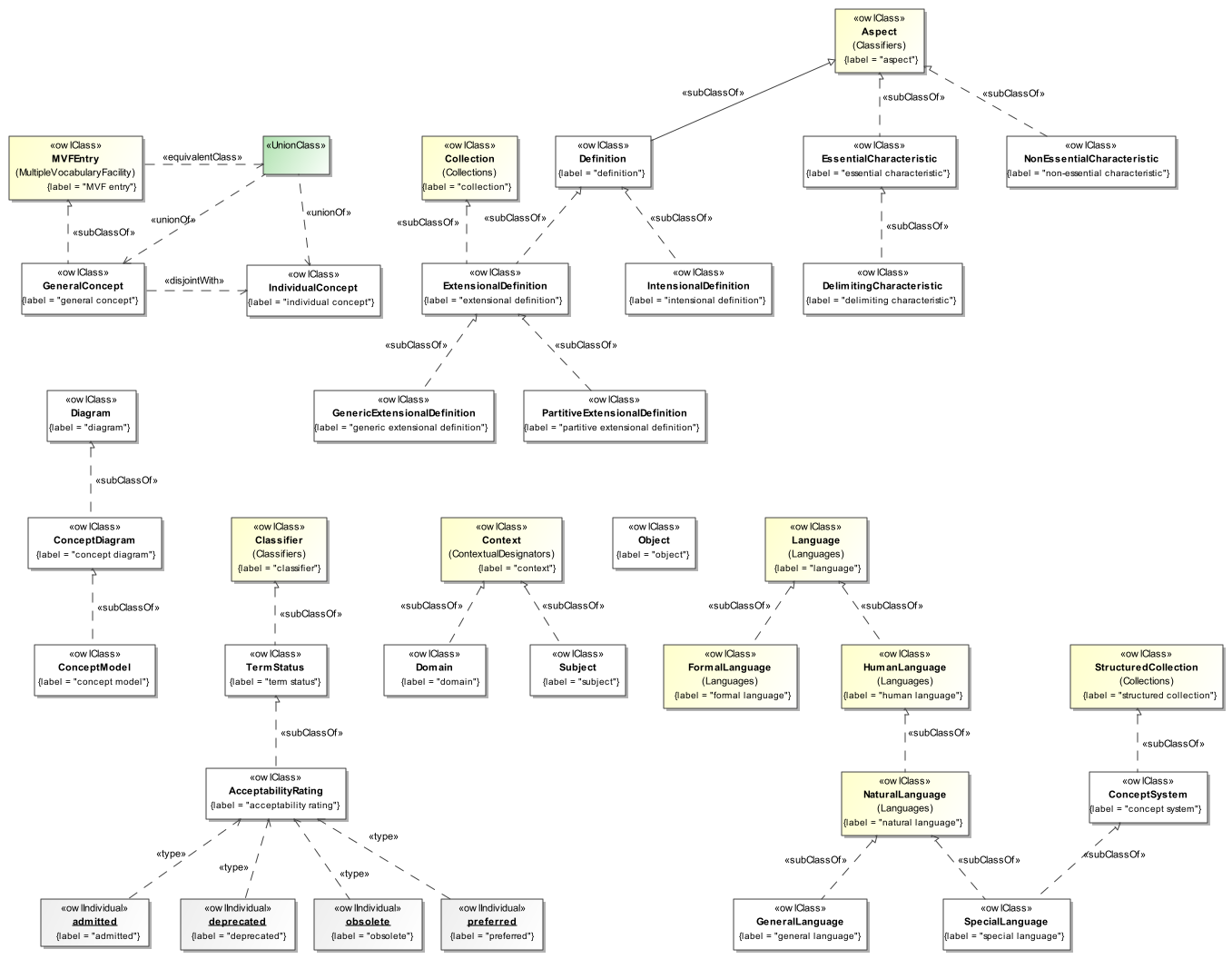
MVF11-39 Create new diagrams showing the composite set of changes made to the ontologies MVF 1.0 MVF 1.1b1 Resolved closed
MVF11-9 In the mapping ontology between SKOS-XL and MVF, the mappings need adjustment MVF 1.0b2 MVF 1.1b1 Resolved closed
MVF11-6 Include a note to explain the use of generalization and context between MVFEntries MVF 1.0b2 MVF 1.1b1 Resolved closed
MVF11-12 The mapping from SKOS Concept to MVF Entry may need further review MVF 1.0b2 MVF 1.1b1 Duplicate or Merged closed
MVF11-10 Incorrect label on mvf-tsc;TermFormation MVF 1.0 MVF 1.1b1 Resolved closed
MVF11-21 MVF should not depend on LCC MVF 1.0 MVF 1.1b1 Resolved closed
MVF11-20 Bad restriction in ontology MVF 1.0 MVF 1.1b1 Resolved closed
MVF11-11 Need an extension in the terminology science ontology for numeric ordering MVF 1.0b2 MVF 1.1b1 Resolved closed
MVF11-15 The constraint on vocabulary entry stating that it denotes exactly 1 MVF entry is incorrect MVF 1.0b2 MVF 1.1b1 Resolved closed
MVF11-18 The constraint in vocabulary entry that it denotes exactly one MVF entry is too narrow MVF 1.0b1 MVF 1.1b1 Resolved closed
MVF11-13 The restriction on MVF Element stating that it can only have one textual name is overly constrained MVF 1.0 MVF 1.1b1 Resolved closed
MVF11-4 The MVF ontology does not reflect the addition of a descriptive reference property MVF 1.0 MVF 1.1b1 Resolved closed
MVF11-1 More examples are needed to demonstrate how to use MVF MVF 1.0a1 MVF 1.1b1 Deferred closed
MVF11-3 Property 'currentMVFEntry' changes the multiplicity, so it should be redefines not subsets MVF 1.0b1 MVF 1.1b1 Closed; No Change closed
MVF11-7 Additional mapping capabilities between MVF entries would be useful MVF 1.0b2 MVF 1.1b1 Deferred closed
MVF11-19 Metamodel property "MVFEntry::context" is unclearly named MVF 1.0 MVF 1.1b1 Deferred closed
MVF11-8 Consider adding more contextual properties to vocabulary entry MVF 1.0b2 MVF 1.1b1 Deferred closed
MVF11-2 The published XMI should be generated as Canonical XMI MVF 1.0a1 MVF 1.1b1 Deferred closed

Issues Descriptions

Having both a vocabulary entry and abbreviation class is redundant

  • Key: MVF11-17
  • Status: closed  
  • Source: Thematix Partners LLC ( Mrs. Elisa F. Kendall)
  • Summary:

    Both the metamodel and ontology include a class called abbreviation, which is a subclass of vocabulary entry. This seems redundant given that there is a constraint representing the notion of whether or not a given vocabulary entry is in fact an abbreviation.

  • Reported: MVF 1.0b1 — Fri, 14 Feb 2025 19:32 GMT
  • Disposition: Resolved — MVF 1.1b1
  • Disposition Summary:

    Having both a vocabulary entry and abbreviation class is redundant

    With respect to the ontologies, deprecating this class and replacing it where appropriate with the relevant restrictions will allow for broader usage and eliminate ambiguity.

    Note that the resolution to this issue, again with respect to the ontologies, depends on the resolutions approved in Ballot #3 for metadata revisions and content merging.

  • Updated: Mon, 30 Mar 2026 14:03 GMT
  • Attachments:

Definitions for a number of core properties are missing from the metamodel section of the MVF specification

  • Key: MVF11-16
  • Status: closed  
  • Source: Thematix Partners LLC ( Mrs. Elisa F. Kendall)
  • Summary:

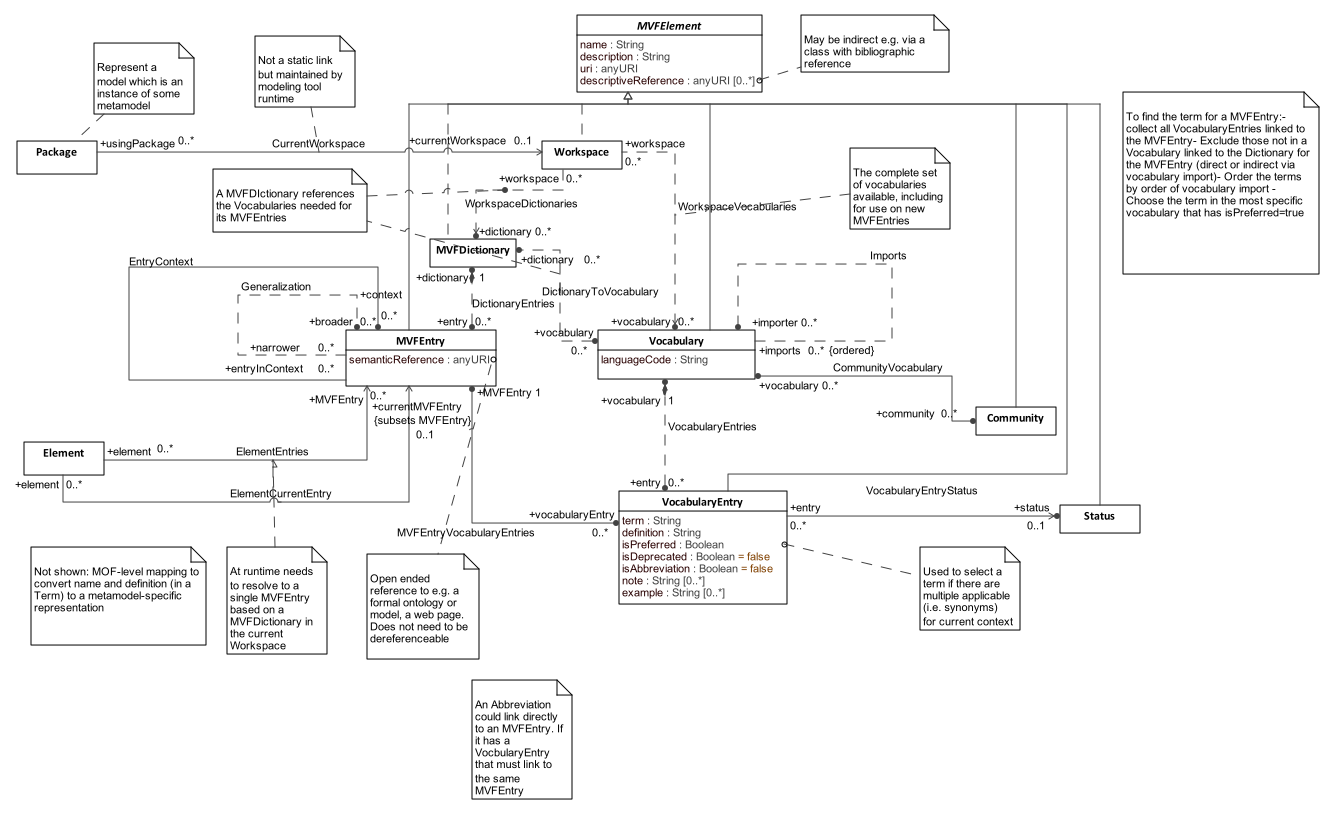
    Currently the specification has definitions for classes, but not for all of the properties used in the metamodel. Some definitions are available in the ontology for these properties, but the metamodel section should be clarified to include them.

  • Reported: MVF 1.0 — Fri, 11 Oct 2024 18:23 GMT
  • Disposition: Resolved — MVF 1.1b1
  • Disposition Summary:

    Add missing definitions to the document

    The missing class definitions are as follows:

    • Package
    • Status
      And the property definitions:
    • MVFEntry::vocabularyEntry
    • Community::vocabulary
      In addition the table for Vocabulary misnames "entry" as "vocabularyEntry"

    Note that Abbreviation is removed by Issue MVF11-17

  • Updated: Mon, 30 Mar 2026 14:03 GMT

Update the informative 'load' file for MVF to incorporate latest metadata

  • Key: MVF11-35
  • Status: closed  
  • Source: Thematix Partners LLC ( Mrs. Elisa F. Kendall)
  • Summary:

    Licensing and other details have been updated in the various MVF ontologies, but that has not been done for the informative 'make file' for ease of loading of the ontologies in various knowledge graphs or other tools.

    This issue strictly involves updating the metadata in that file, with no change to the specification itself. It depends on the resolution of issues in Ballots #2 and #3.

  • Reported: MVF 1.0 — Tue, 11 Nov 2025 00:27 GMT
  • Disposition: Resolved — MVF 1.1b1
  • Disposition Summary:

    Update the informative 'load' file for MVF to incorporate latest metadata

    The resolution to this issue only involves the 'load file', machine-readable AboutMVF vocabulary, and does not impact the text of the specification.

  • Updated: Mon, 30 Mar 2026 14:03 GMT
  • Attachments:

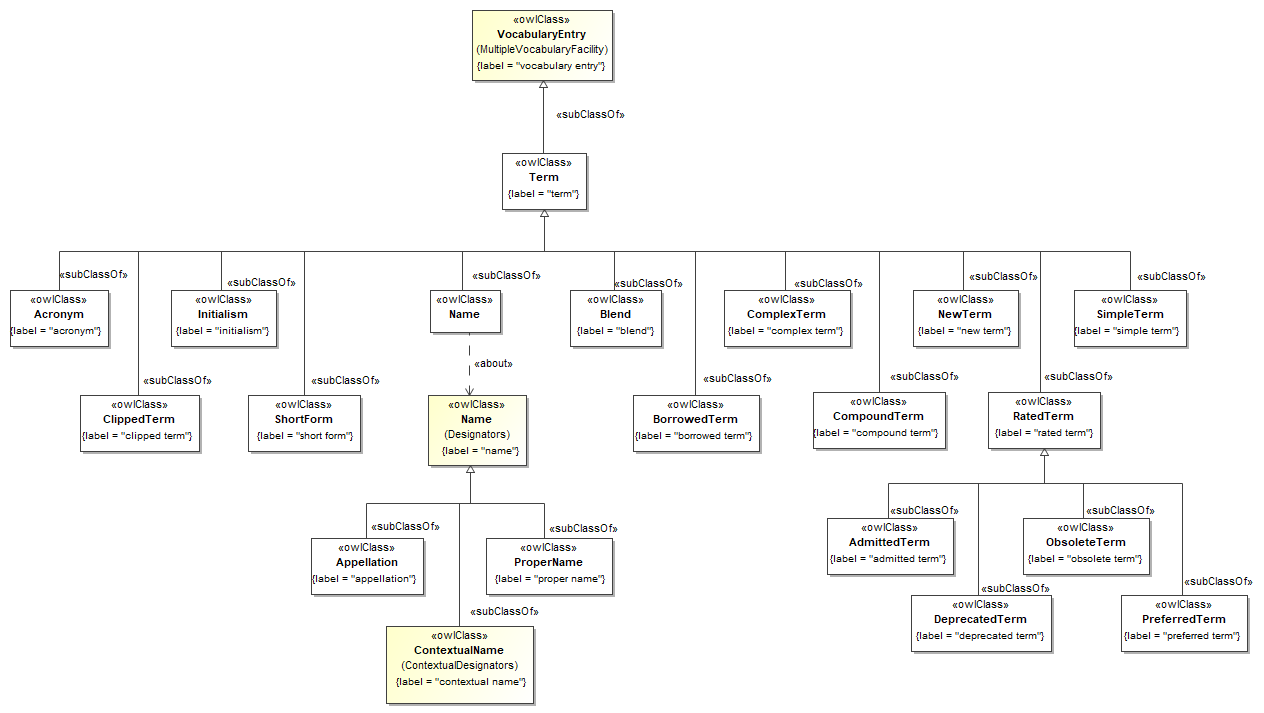
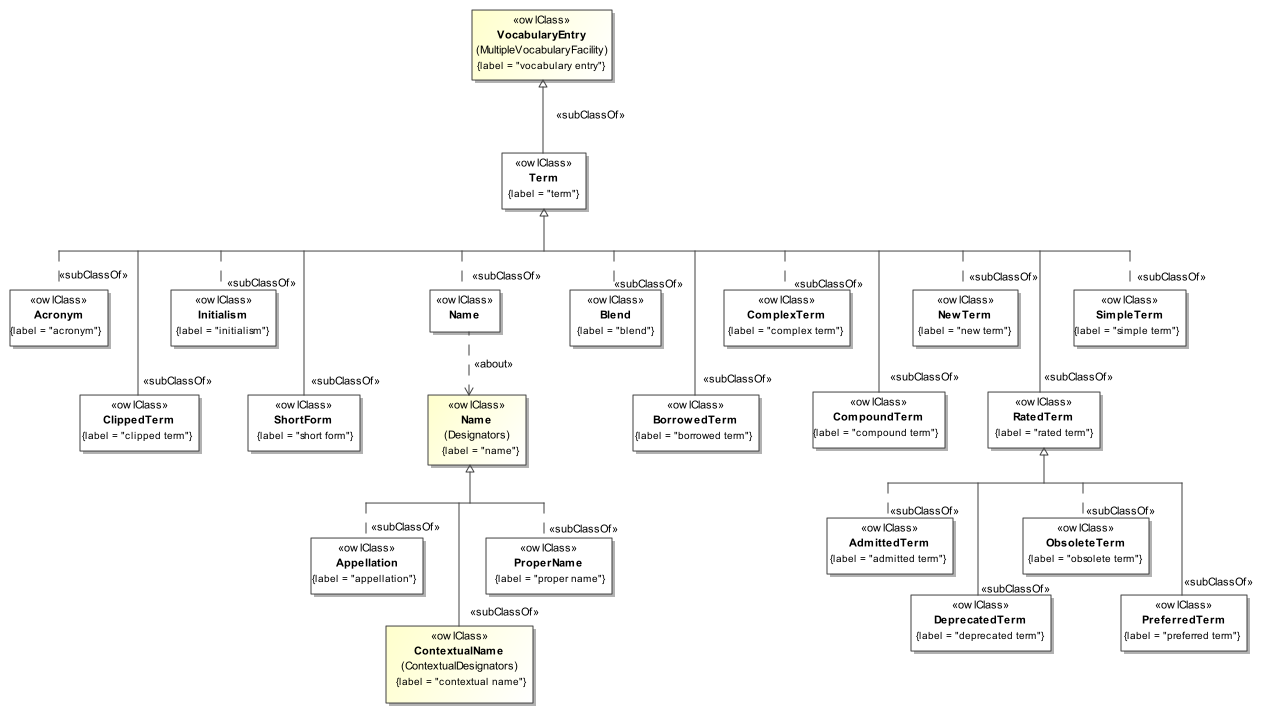
Create new diagrams showing the composite set of changes made to the ontologies


In the mapping ontology between SKOS-XL and MVF, the mappings need adjustment

  • Key: MVF11-9
  • Status: closed  
  • Source: Thematix Partners LLC ( Mrs. Elisa F. Kendall)
  • Summary:

    Currently we've mapped MVFEntry to SKOS Concept, and it should be Vocabulary Entry to SKOS Concept. Likewise, the mapping between MVF Concept System to ConceptSystem should be to Vocabulary in MVF.

  • Reported: MVF 1.0b2 — Fri, 19 Jan 2024 19:44 GMT
  • Disposition: Resolved — MVF 1.1b1
  • Disposition Summary:

    In the mapping ontology between SKOS-XL and MVF, the mappings need adjustment

    This issue involves changes to the mapping ontology between SKOS-XL and MVF, and does not change any of the other primary ontologies.

    It depends on the resolutions to other issues including in Ballot #3 in order to align the mapping with the latest revisions to the ontologies.

  • Updated: Mon, 30 Mar 2026 14:03 GMT
  • Attachments:

Include a note to explain the use of generalization and context between MVFEntries

  • Key: MVF11-6
  • Status: closed  
  • Source: Thematix Partners LLC ( Mrs. Elisa F. Kendall)
  • Summary:

    This represents a generalization as in UML or OWL, at the metamodel level rather than at the UML model level. This may be confusing to users and so an explanatory note is needed to help. Note that the ramifications of this are at the instance level - one instance of an MVF entry may be a generalization of another instance of an MVF entry.

    The same is true of the additional relationship, which is context, where notes and examples would also be helpful.

  • Reported: MVF 1.0b2 — Fri, 19 Jan 2024 19:15 GMT
  • Disposition: Resolved — MVF 1.1b1
  • Disposition Summary:

    Expand the notes for broader and context

    Add the notes and examples requested.

  • Updated: Mon, 30 Mar 2026 14:03 GMT

The mapping from SKOS Concept to MVF Entry may need further review

  • Key: MVF11-12
  • Status: closed  
  • Source: Thematix Partners LLC ( Mrs. Elisa F. Kendall)
  • Summary:

    While the definition of MVF entry and that of SKOS concept appear to be the same, there are differences in how SKOS is used. That may, in fact mean we should consider mapping to MVF Vocabulary Entry instead.

    Regardless, it would be useful to provide a discussion in the specification about the possibility, depending on the application.

  • Reported: MVF 1.0b2 — Fri, 8 Mar 2024 19:18 GMT
  • Disposition: Duplicate or Merged — MVF 1.1b1
  • Disposition Summary:

    The mapping from SKOS Concept to MVF Entry may need further review

    This issue is essentially the same as MVF11-9, though not identical. Having said this, the suggested resolution is precisely what was done in the resolution of MVF11-9.

  • Updated: Mon, 30 Mar 2026 14:03 GMT

Incorrect label on mvf-tsc;TermFormation

  • Key: MVF11-10
  • Status: closed  
  • Source: Thematix Partners LLC ( Mrs. Elisa F. Kendall)
  • Summary:

    The label in the terminology science ontology reads 'term harmonization' and should be 'term formation'.

    This issue affects only that ontology, not the documentation for it.

  • Reported: MVF 1.0 — Wed, 28 Feb 2024 19:11 GMT
  • Disposition: Resolved — MVF 1.1b1
  • Disposition Summary:

    Incorrect label on mvf:TermFormation

    The resolution to this issue depends on the resolution of MVF11-21, which revises the metadata on the ISO1087-TerminologyScience ontology.

    The change does not impact the specification document, only a very minor change to the ontology, namely to change the label on the class from 'term harmonization' to 'term formation'.

  • Updated: Mon, 30 Mar 2026 14:03 GMT
  • Attachments:

MVF should not depend on LCC

  • Key: MVF11-21
  • Status: closed  
  • Source: Thematix Partners LLC ( Mrs. Elisa F. Kendall)
  • Summary:

    The MVF ontologies depend on LCC for the definition of Language, as do other standards. The joint MVF and Commons RTF teams agree this should be added to the Commons library, and then MVF should be modified to use Commons rather than LCC.

  • Reported: MVF 1.0 — Fri, 23 May 2025 19:00 GMT
  • Disposition: Resolved — MVF 1.1b1
  • Disposition Summary:

    Revise MVF to reuse Commons 1.3 ontologies rather than LCC

    This resolution depends on the metadata and other ontology changes described in MVF11-13, MVF11-18, and MVF11-15 (Ballot #2).

    Eliminating dependencies on the LCC ontologies, while enabling their use in specific applications, such as to reuse the individual definitions of various languages from ISO 639 and countries from ISO 3166, will simplify the MVF ontologies and make them more reusable.

    The changes described in the revised text and attached ontologies are needed to support usability and reuse requirements of various users, including the Retail Domain Task Force and for Identification of Medicinal Products (IDMP-O) developed by the EDM Association and Pistoia Alliance members.

  • Updated: Mon, 30 Mar 2026 14:02 GMT
  • Attachments:

Bad restriction in ontology

  • Key: MVF11-20
  • Status: closed  
  • Source: Adaptive ( Mr. Pete Rivett)
  • Summary:

    We need a new property to link MVFentry to its VocabularyEntries.
    The problem is this bad restriction on MVFentry:
    <owl:Restriction>
    <owl:onProperty rdf:resource="&mvf;hasVocabularyEntry"/>
    <owl:onClass rdf:resource="&mvf;VocabularyEntry"/>
    <owl:minQualifiedCardinality rdf:datatype="&xsd;nonNegativeInteger">0</owl:minQualifiedCardinality>
    </owl:Restriction>
    However hasVocabularyEntry is specifically for linking with a Vocabulary. If used to link an MVFEntry with its VocabularyEntries then the MVFEntry will get inferred to be a VOcabulary due to the following::
    <owl:ObjectProperty rdf:about="&mvf;isInVocabulary">
    <rdfs:subPropertyOf rdf:resource="&cmns-col;isMemberOf"/>
    <rdfs:label>is in vocabulary</rdfs:label>
    <rdfs:range rdf:resource="&mvf;Vocabulary"/>
    <owl:inverseOf rdf:resource="&mvf;hasVocabularyEntry"/>
    <skos:definition>has containing vocabulary</skos:definition>
    </owl:ObjectProperty>

  • Reported: MVF 1.0 — Fri, 28 Mar 2025 23:33 GMT
  • Disposition: Resolved — MVF 1.1b1
  • Disposition Summary:

    Overly constraining inverse on property isInVocabulary

    The resolution to this issue depends on the resolution to MVF11-15, to include all of the metadata changes made in Ballot 2.

    The challenging restriction isn't the issue here (and doesn't exist). Currently, there is a link between MVF entry and vocabulary entry - an MVF entry 'is signified by' min 0 vocabulary entry. The inverse is on vocabulary entry, and after MVF11-15, states that a vocabulary entry denotes max 1 MVF entry.

    However, to ensure that there are no issues in saying that a given vocabulary entry can occur in things other than vocabularies, we can relax the inverse on the property isInVocabulary.

  • Updated: Mon, 30 Mar 2026 14:02 GMT
  • Attachments:

Need an extension in the terminology science ontology for numeric ordering

  • Key: MVF11-11
  • Status: closed  
  • Source: Thematix Partners LLC ( Mrs. Elisa F. Kendall)
  • Summary:

    A numeric ordering is a kind of systematic ordering, with a couple of important attributes: (1) what the origin is – zero or one, typically, and (2) whether it is from low to high or high to low. Typically numeric orderings of collections use positive integers, but there could be other kinds of ordering that use, for example, alphabetical with numerals and/or distinctions by rank, such as A.1.1.

    There may also be utility in having the notion of 'position', such as a position in an ordered list, or position of a term in a text.

    We have not captured this clearly in the ontology and should.

  • Reported: MVF 1.0b2 — Thu, 7 Mar 2024 20:09 GMT
  • Disposition: Resolved — MVF 1.1b1
  • Disposition Summary:

    Need an extension in the terminology science ontology for numeric ordering

    This resolution adds two kinds of systematic orderings: (1) numeric order, as requested by the issue, and (2) chronological order, which is also common in collections, concept systems, nomenclatures and the like and was also missing.

    It depends on the resolution of MVF11-21 for metadata changes to the ontology.

  • Updated: Mon, 30 Mar 2026 14:02 GMT
  • Attachments:

The constraint on vocabulary entry stating that it denotes exactly 1 MVF entry is incorrect

  • Key: MVF11-15
  • Status: closed  
  • Source: Thematix Partners LLC ( Mrs. Elisa F. Kendall)
  • Summary:

    While typically one would associate a vocabulary entry with only one MVF entry, this does not allow for cases when a vocabulary includes more entries than are mapped to MVF entries. Thus, one could have terms that either are not needed or have yet to be mapped, and the restriction would result in wrong results (or a rule that exercises the restriction could do so).

    The restriction in the MVF ontology should be modified to 'max 1' from exactly 1, and the redundant restriction in the ISO 1087 ontology that says 'min 0' should be eliminated.

  • Reported: MVF 1.0b2 — Wed, 19 Jun 2024 18:45 GMT
  • Disposition: Resolved — MVF 1.1b1
  • Disposition Summary:

    The constraint on vocabulary entry stating that it denotes exactly 1 MVF entry is incorrect

    This issue was largely addressed by the resolution to MVF11-18, on which it depends and on MVF11-13 with respect to metadata.

    However, it removes a redundant constraint on the class 'vocabulary entry' that was mistakenly added in the ISO 1087 Terms and Definitions ontology.

  • Updated: Mon, 30 Mar 2026 14:02 GMT
  • Attachments:

The constraint in vocabulary entry that it denotes exactly one MVF entry is too narrow

  • Key: MVF11-18
  • Status: closed  
  • Source: Thematix Partners LLC ( Mrs. Elisa F. Kendall)
  • Summary:

    There may be cases that vocabularies may not have a relationship with an MVF entry. The constraint should be loosened to be [0..1].

  • Reported: MVF 1.0b1 — Fri, 14 Feb 2025 19:39 GMT
  • Disposition: Resolved — MVF 1.1b1
  • Disposition Summary:

    The constraint in vocabulary entry that it denotes exactly one MVF entry is too narrow

    The resolution to this issue depends on the resolution to MVF11-13, which addresses revisions to the metadata for the ontology.

    The resolution simply revises the cardinality on VocabularyEntry, on the property denotes, to change the cardinality from exactly 1 to max 1.

  • Updated: Mon, 30 Mar 2026 14:02 GMT
  • Attachments:

The restriction on MVF Element stating that it can only have one textual name is overly constrained

  • Key: MVF11-13
  • Status: closed  
  • Source: Thematix Partners LLC ( Mrs. Elisa F. Kendall)
  • Summary:

    MVF element is the parent class of both MVF entry and vocabulary entry. A given term, which is a vocabulary entry may be used in various ways, and in some cases may have multiple textual names. This isn't common, but does happen in practice, especially in cases involving legacy data.

    One case we have found on the IDMP-O project is that there are two sources for the same term. The European Medicines Agency publishes controlled vocabularies are specified in the EMA SPOR reference ontology (RMS). That ontology includes not only EMA SPOR controlled vocabularies but duplicates a subset of the controlled vocabularies from MEDdra (Medical Dictionary For Regulatory Activities). In the IDMP representation of various pharmaceutical products, both controlled vocabularies are required for use in the EU. Thus we have the EMA SPOR version of the MEDdra term and the actual MEDdra term, which we map to one another using owl:sameAs. That results in a logical inconsistency because we have more than one term name for the same term. We have similar issues with certain FDA controlled vocabularies, where they have identifiers specified in the GSRS and UNII repositories, that are actually the same identifier, thus resulting in two textual names for the same thing.

    There may be a requirement for some implementations to use a SHACL shape for this, but for information content, such as the specifications for certain substance names, simply relaxing the restriction from exactly one to some values from would provide the semantics we need.

  • Reported: MVF 1.0 — Tue, 23 Apr 2024 16:49 GMT
  • Disposition: Resolved — MVF 1.1b1
  • Disposition Summary:

    Loosen constraints on MVF Element to allow for mapping across vocabularies for duplicated terms

    There are a number of cases where the terms used for representation and identification of substances, drugs, and other manufactured items are repeated across controlled vocabularies. In some cases they use the same identifier and IRI though not always.

    When such terms are clearly duplicates, an ideal mapping would use owl:sameAs. However, MVFElement only allows for one IRI, name and description and thus such mappings, even for identical terms, make the resulting graph logically inconsistent.

    Note too that the property, hasTextualName, has been added to Commons and that property should be reused by MVF, deprecating the existing duplicate.

  • Updated: Mon, 30 Mar 2026 14:02 GMT
  • Attachments:

The MVF ontology does not reflect the addition of a descriptive reference property

  • Key: MVF11-4
  • Status: closed  
  • Source: Thematix Partners LLC ( Mrs. Elisa F. Kendall)
  • Summary:

    Just prior to publication of the FTF report, a new property was added to the metamodel called descriptiveReference. This property, which is quite useful, was not added to the ontology, however, and may eliminate the need for restrictions using the Commons is defined by (cmns-dsg;isDefinedBy) property on VocabularyEntry.

  • Reported: MVF 1.0 — Fri, 28 Jul 2023 18:51 GMT
  • Disposition: Resolved — MVF 1.1b1
  • Disposition Summary:

    The MVF ontology does not reflect the addition of a descriptive reference property

    The resolution to this issue adds the equivalent data property for a descriptive reference to the MVF ontology, together with a restriction on MVF element to match the metamodel.

    It depends on the resolutions approved in Ballot #2 for metadata purposes.

  • Updated: Mon, 30 Mar 2026 14:02 GMT
  • Attachments:

More examples are needed to demonstrate how to use MVF

  • Key: MVF11-1
  • Status: closed  
  • Source: Thematix Partners LLC ( Mrs. Elisa F. Kendall)
  • Summary:

    There is an example in Annex B that is quite useful, but is not multilingual. Since we have said that MVF can be used to support multiple natural languages, we need at least one additional example to cover that use case. We might also include a broader example showing how to represent a general vocabulary in MVF, such as the AI PTF emerging vocabulary for artificial intelligence, to show how this can be done.

  • Reported: MVF 1.0a1 — Fri, 13 Jan 2023 19:35 GMT
  • Disposition: Deferred — MVF 1.1b1
  • Disposition Summary:

    More examples are needed to demonstrate how to use MVF

    While the RTF agrees that we need more examples, and, in fact, we've been working to add a new annex with some work done by Stephen Powley through his Ph.D. thesis at Coventry, we believe more time is needed to add that annex and integrate any additional changes needed to support his findings.

    We also plan to add examples specifically related to use of the ontologies, based on the work underway between EDMA and the Pistoia Alliance on the Identification of Medicinal Products (IDMP-O) ontology. Again, doing so will take additional time, and some of the changes incorporated in the 1.1 revisions are needed for IDMP-O in order to support those examples and other use cases in early 2026. Having the revisions be included and dereferenceable is critical for IDMP-O.

  • Updated: Mon, 30 Mar 2026 14:02 GMT

Property 'currentMVFEntry' changes the multiplicity, so it should be redefines not subsets

  • Key: MVF11-3
  • Status: closed  
  • Source: Coventry University ( Mr. Stephen Powley)
  • Summary:

    The property 'currentMVFEntry' on the association ElementCurrentEntry changes the multiplicity from 0..* to 0..1, so it should be redefines not subsets (or the parent multiplicity needs to be changed)

  • Reported: MVF 1.0b1 — Wed, 7 Jun 2023 22:54 GMT
  • Disposition: Closed; No Change — MVF 1.1b1
  • Disposition Summary:

    Property 'currentMVFEntry' changes the multiplicity, so it should be redefines not subsets

    The intent of ElementCurrentEntry is to select from several linked MVF entries., and allow that selection to change between them. hence it does not override the full set but selects one from them, of which it needs to be a (single-member) subset. So the model is correct in this regard.

  • Updated: Mon, 30 Mar 2026 14:02 GMT

Additional mapping capabilities between MVF entries would be useful

  • Key: MVF11-7
  • Status: closed  
  • Source: Thematix Partners LLC ( Mrs. Elisa F. Kendall)
  • Summary:

    This might be a new area of exploration, and could apply beyond MVF entries in the context of MVF.

    Currently the metamodel reflects SKOS-like relations such as broader and narrower, but more is needed for certain applications.

    It would be useful to have a non-normative annex demonstrating how one could do this as a starting point for MVF users.

  • Reported: MVF 1.0b2 — Fri, 19 Jan 2024 19:21 GMT
  • Disposition: Deferred — MVF 1.1b1
  • Disposition Summary:

    Additional mapping capabilities between MVF entries would be useful

    The 1.1 RTF has been working with Stephen Powley through his Ph.D. thesis at Coventry, to investigate extending the metamodel and ontology to incorporate more nuanced mapping properties as well as examples to support those extensions.

    This work is still underway, however, and we believe requires more effort, including additional testing and documentation, prior to inclusion in MVF. We think it is important however, and that it could provide significant value to the broader community, and so we plan to focus more on this for the MVF 1.2 RTF.

  • Updated: Mon, 30 Mar 2026 14:02 GMT

Metamodel property "MVFEntry::context" is unclearly named

  • Key: MVF11-19
  • Status: closed  
  • Source: Adaptive ( Mr. Pete Rivett)
  • Summary:

    The purpose is to reflect the equivalent of package ownership in a source model: the name should better reflect that.

  • Reported: MVF 1.0 — Fri, 28 Feb 2025 19:29 GMT
  • Disposition: Deferred — MVF 1.1b1
  • Disposition Summary:

    Metamodel property "MVFEntry::context" is unclearly named

    The idea behind this is that a given MVF entry may point to another MVF entry that provides context, but it needs more research and some testing. As a consequence, the RTF elected to defer this for MVF 1.1.

  • Updated: Mon, 30 Mar 2026 14:02 GMT

Consider adding more contextual properties to vocabulary entry

  • Key: MVF11-8
  • Status: closed  
  • Source: Thematix Partners LLC ( Mrs. Elisa F. Kendall)
  • Summary:

    Investigate whether this should be on vocabulary, vocabulary entry, both, and/or possibly on a more general element as well.

    There may also be an impact on the ontology, depending on the resolution.

  • Reported: MVF 1.0b2 — Fri, 19 Jan 2024 19:36 GMT
  • Disposition: Deferred — MVF 1.1b1
  • Disposition Summary:

    Consider adding more contextual properties to vocabulary entry

    This issue is more of an enhancement and is a bit vague. We need some examples / use cases to tease out what might be valuable to add in this case. Thus, the RTF decided to defer to MVF 1.2.

  • Updated: Mon, 30 Mar 2026 14:02 GMT

The published XMI should be generated as Canonical XMI

  • Key: MVF11-2
  • Status: closed  
  • Source: Thematix Partners LLC ( Mrs. Elisa F. Kendall)
  • Summary:

    MVF users have requested that the form of the XMI that is provided as a part of the MVF specification be canonical XMI.

  • Reported: MVF 1.0a1 — Fri, 14 Apr 2023 18:18 GMT
  • Disposition: Deferred — MVF 1.1b1
  • Disposition Summary:

    The published XMI should be generated as Canonical XMI

    Canonical XMI generation is currently mainly manual, and some scripting work or other development is needed in order to make this more consistent, not only for MVF but more generally.

    We are deferring this due to limited resources to create the requisite artifacts and document them in an annex at this time, given that it is lower priority than some of the other revisions needed for MVF users.

  • Updated: Mon, 30 Mar 2026 14:02 GMT