Business Architecture Core Metamodel Avatar
  1. OMG Specification

Business Architecture Core Metamodel — Closed Issues

  • Acronym: BACM
  • Issues Count: 19
  • Description: Issues resolved by a task force and approved by Board
Closed All
Issues resolved by a task force and approved by Board

Issues Summary

Key Issue Reported Fixed Disposition Status
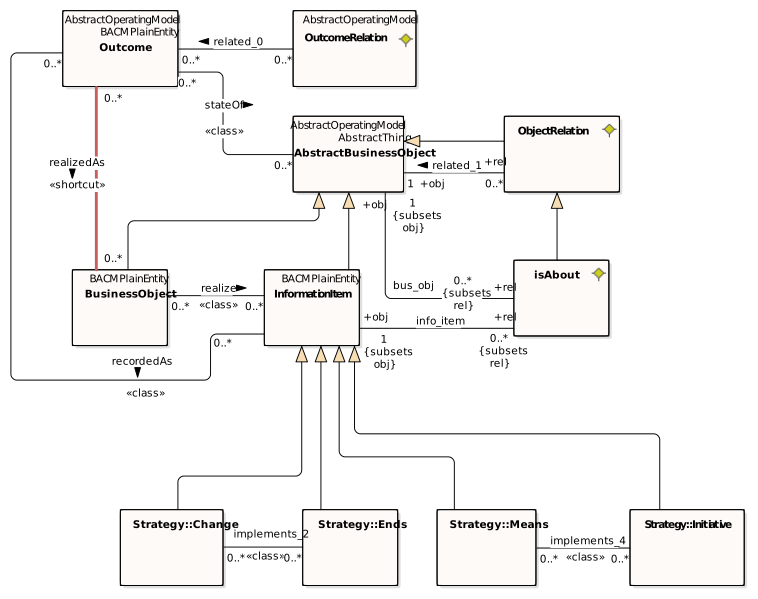
BACM12-35 Clarify that reified relations such as OutcomeRelation are aggregations BACM 1.1b1 BACM 1.2b1 Duplicate or Merged closed
BACM12-16 Need outcome to represent state during execution of value stream stages, and abstract capabilities. BACM 1.1b1 BACM 1.2b1 Resolved closed
BACM12-39 Change sections 7.2.1.6 and 7.2.3 to remove individual stereotype BACM 1.1b1 BACM 1.2b1 Resolved closed
BACM12-36 Semantics of reified relations should be aggregation BACM 1.1b1 BACM 1.2b1 Resolved closed
BACM12-3 Operating Value Streams BACM 1.0b2 BACM 1.2b1 Closed; No Change closed
BACM12-6 Consider adding logical relations for combining Outcomes BACM 1.0b2 BACM 1.2b1 Duplicate or Merged closed
BACM12-13 The Owl ontology does not record abstract=True from the XMI BACM 1.1b1 BACM 1.2b1 Resolved closed
BACM12-11 Owl ontology is missing required descriptive elements BACM 1.1b1 BACM 1.2b1 Resolved closed
BACM12-14 Define an annotation property to capture the meta relation in models BACM 1.1b1 BACM 1.2b1 Resolved closed
BACM12-10 Missing specialization relationships BACM 1.1b1 BACM 1.2b1 Resolved closed
BACM12-8 Owl ontology incorrect restriction definitions BACM 1.1b1 BACM 1.2b1 Resolved closed
BACM12-26 UML datatype PrimitiveTypes.xmi#Integer not translated into TTL BACM 1.1b1 BACM 1.2b1 Resolved closed
BACM12-15 Translation of owns associations to TTL BACM 1.1b1 BACM 1.2b1 Resolved closed
BACM12-2 Define JSON interchange specification BACM 1.0b2 BACM 1.2b1 Deferred closed
BACM12-9 Owl Ontology incorrect restrictions - onDataRange BACM 1.1b1 BACM 1.2b1 Duplicate or Merged closed
BACM12-12 Annotation axioms missing from OWL ontology BACM 1.1b1 BACM 1.2b1 Resolved closed
BACM12-5 No relationship between ProductOffering and Customer BACM 1.0b2 BACM 1.2b1 Deferred closed
BACM12-4 Binding object BACM 1.0b2 BACM 1.2b1 Deferred closed
BACM12-1 Reconsider the packaging and namespace conventions BACM 1.0b2 BACM 1.2b1 Deferred closed

Issues Descriptions

Clarify that reified relations such as OutcomeRelation are aggregations

  • Key: BACM12-35
  • Status: closed  
  • Source: Thematix Partners LLC ( Mr. James Rhyne)
  • Summary:

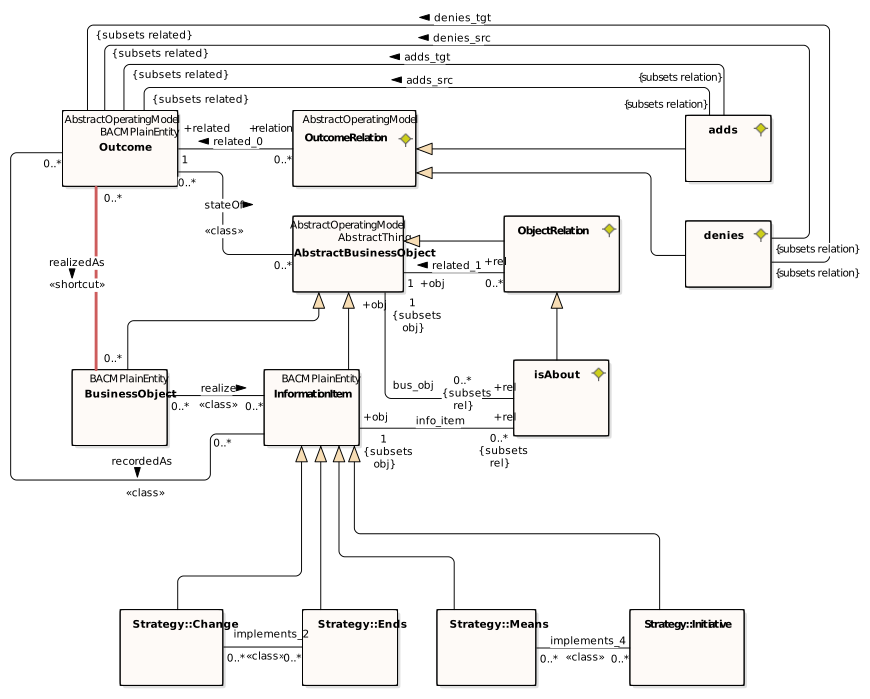
    The 1.1 documentation does not specify that semantics of specialization or ownership do not apply to reified relations. This can be resolved by altering the description of BACMRelation to state that the semantics prohibit a semantic interpretation of composition or a semantic interpretation of specialization.

  • Reported: BACM 1.1b1 — Thu, 15 Jan 2026 18:53 GMT
  • Disposition: Duplicate or Merged — BACM 1.2b1
  • Disposition Summary:

    Duplicates BACM12-36

    Duplicates BACM12-36

  • Updated: Thu, 17 Sep 2026 01:13 GMT
Need outcome to represent state during execution of value stream stages, and abstract capabilities.

  • Key: BACM12-16
  • Status: closed  
  • Source: Thematix Partners LLC ( Mr. James Rhyne)
  • Summary:

    In prototyping the Guild transportation reference model, it became apparent that the 1.1 metamodel does not support the notion of outcomes associated with the execution of value stream stages or abstract capabilities. For example, safety and comfort of the traveler are outcomes that have high value in the value proposition, They are continuously associated with the enroute stage of the value stream and are not appropriately characterized as exit-criteria, which are outcomes associated with the ending of the stage.
    Such outcomes should be associated with capabilities such as conveyor operations to indicate that the outcome is in force throughout the exeuction of the capability.

  • Reported: BACM 1.1b1 — Fri, 24 Oct 2025 18:19 GMT
  • Disposition: Resolved — BACM 1.2b1
  • Disposition Summary:

    Add statecharts-like metamodel elements

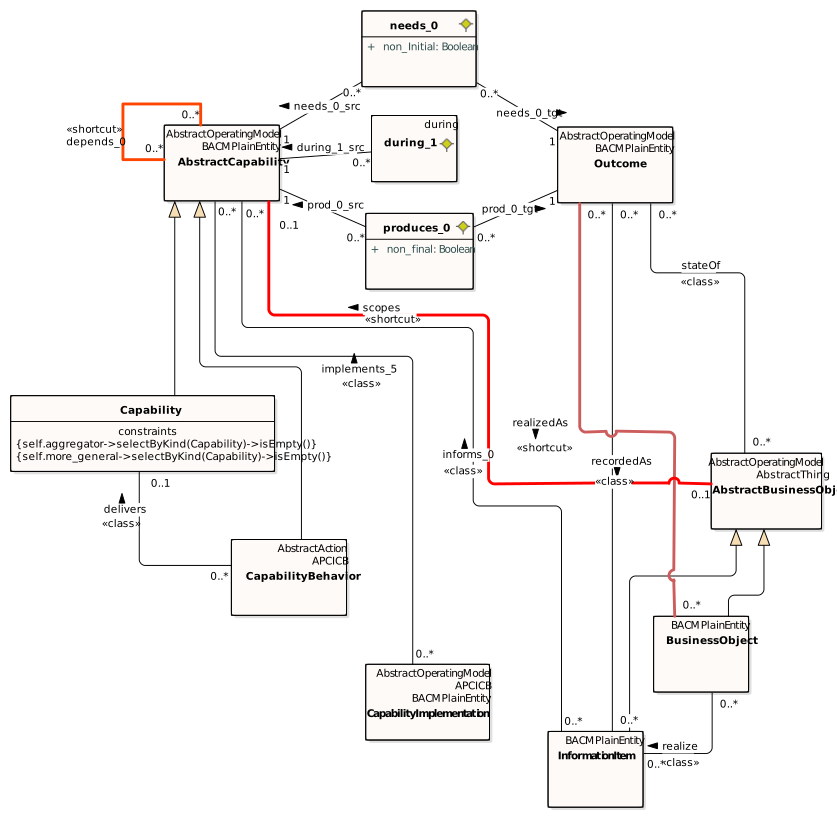
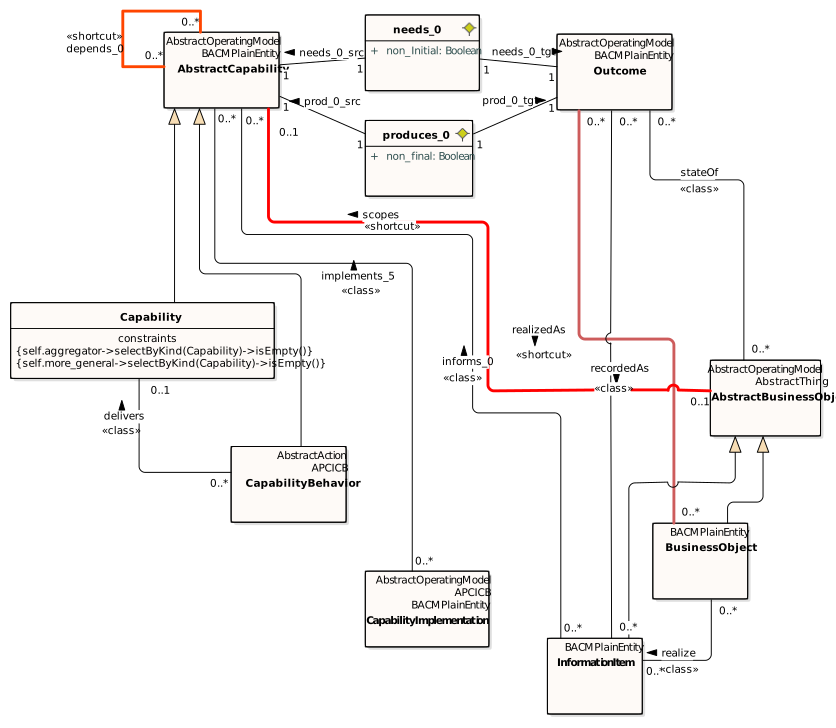
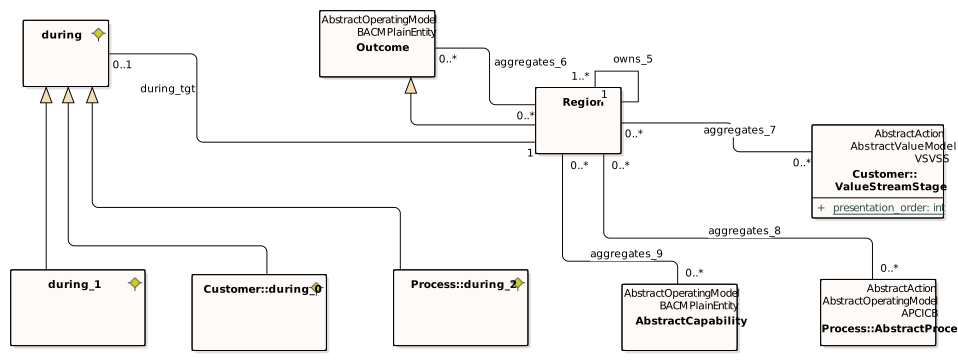
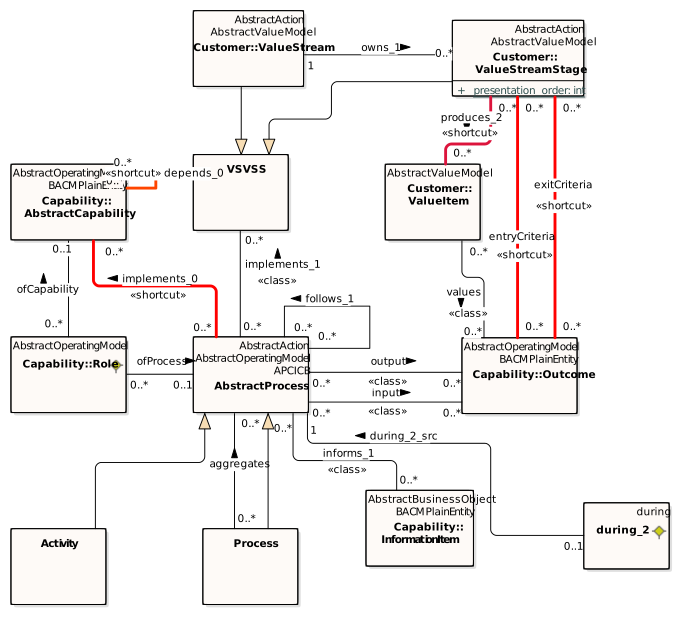
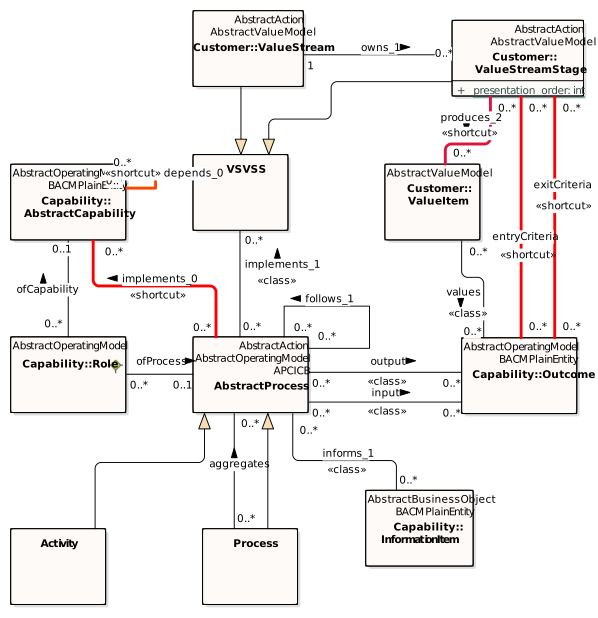
    The proposal creates a new subtype of Outcome, named Region, that is associated to AbstractCapability, AbstractProcess, or ValueStreamStage by a reified relation named "during". Region aggregates AbstractCapabilities, AbstractProcesses, ValueStreamStages and Outcomes. An implementing tool must also aggregate needs/produces, inputs/outputs, or entry/exit criteria that relate the aggregated elements. The result should create in each Region, a network that describes behaviors in terms of Outcomes linked by AbstractCapabilities, AbstractProcesses or ValueStreamStages. For completeness, the Outcomes needed and produced by the AbstractCapability, AbstractProcess, or ValueStreamStage, whose behavior is being described by "during" related Regions, should also be part of the network in some of these Regions. Regions may be decomposed and the child Regions are presumed to behave independently unless they create Outcomes that are consumed in another region; such a creation/cunsumption relation implies a point of synchronization between the Regions.
    The effect of these changes is to allow a lightweight statecharts model to be used to describe behaviors.

  • Updated: Thu, 17 Sep 2026 01:13 GMT
  • Attachments:

Change sections 7.2.1.6 and 7.2.3 to remove individual stereotype

  • Key: BACM12-39
  • Status: closed  
  • Source: Thematix Partners LLC ( Mr. James Rhyne)
  • Summary:

    The 1.1b1 model no longer has theBusiness as an <<individual>> stereotyped class, and the <<individual>> stereotype has been removed. All classes now represent sets of individuals.

  • Reported: BACM 1.1b1 — Thu, 15 Jan 2026 19:51 GMT
  • Disposition: Resolved — BACM 1.2b1
  • Disposition Summary:

    Changes to prose in 7.2.1.6 and 7.2.3

    Delete 7.2.1.6.
    Make changes to 7.2.3 as revised

  • Updated: Thu, 17 Sep 2026 01:13 GMT
Semantics of reified relations should be aggregation

  • Key: BACM12-36
  • Status: closed  
  • Source: Thematix Partners LLC ( Mr. James Rhyne)
  • Summary:

    The BACM 1.1b1 document does not explicitly state that the semantics of all reified relations is aggregation, leading to a possible interpretation of these relationships as ownership or specialization. The BACM 1.1b1 document explicitly provides simple relations of specialization, composition and aggregation. All simple associations and all stereotyped associations should be interpreted as aggregations only.

  • Reported: BACM 1.1b1 — Thu, 15 Jan 2026 19:13 GMT
  • Disposition: Resolved — BACM 1.2b1
  • Disposition Summary:

    Change 7.2 to clarify aggregational semantics of reified and non-reified relations

    Change text in sections 7.2.1.2, 7.2.1.3 and 7.2.1.4 to explain that these relations have the semantics of aggregation and should not be interpreted as composition or specialization.

  • Updated: Thu, 17 Sep 2026 01:13 GMT
Operating Value Streams

  • Key: BACM12-3
  • Status: closed  
  • Source: Thematix Partners LLC ( Mr. James Rhyne)
  • Summary:

    Some organizations have developed what they call operating value streams. Sometimes these arise from application of "Lean" methdology. But, they may also arise from a desire to model the creation of value associated with particular product lines and analyze those representations of value with respect to the generic models of value creation provided by value streams.
    Specialization of value streams and stages is disallowed by the BIZBOK (to avoid the common methodological mistake of conflating value streams and processes). Is there a need for operating value streams? Is there a way to represent this that does not violate the BIZBOK?

  • Reported: BACM 1.0b2 — Thu, 7 Mar 2024 18:11 GMT
  • Disposition: Closed; No Change — BACM 1.2b1
  • Disposition Summary:

    There is no consensus on the definition of an operating value stream

    Nothing in the BACM prevents a modeler from creating a value stream that the modeler would judge to be an operating value stream. However, there is not a consensus on what relationship if any should be expressed or construed between an operating value stream and another value stream that might be considered to be a generalization. A frequently cited case would have a manufacturer of widgets, having a strategic value stream for widget production, decide to create an operating value stream for a specific widget type. The unresolved question is the rules of compliance between the strategic value stream and the operating value stream.

  • Updated: Thu, 17 Sep 2026 01:13 GMT
Consider adding logical relations for combining Outcomes

  • Key: BACM12-6
  • Status: closed  
  • Source: Thematix Partners LLC ( Mr. James Rhyne)
  • Summary:

    The current draft provides OutcomeRelation as a template for the model level definition of relations between outcomes. Recent work on entry and exit criteria for value streams as well as capability and process flows has informally used logical relationships that instance/specialie OutcomeRelation and effectively define an Outcome that is the logical union or other Outcomes. The issue is whether the metamodel should define a set of specifically logical relations. For example include, exclude, include complement could be used to create an Outcome by conjunctive composition where the semantics of the Outcome is the union of all facts from included Outcomes, no facts from excluded Outcomes (i.e.not known whether these are true or false), complement facts from included complement Outcomes. This is just an example; specific proposal to be worked out.

  • Reported: BACM 1.0b2 — Mon, 19 Aug 2024 16:46 GMT
  • Disposition: Duplicate or Merged — BACM 1.2b1
  • Disposition Summary:

    See proposal BACM12-42 for issue BACM12-16

    See proposal BACM12-42 for issue BACM12-16

  • Updated: Thu, 17 Sep 2026 01:13 GMT
The Owl ontology does not record abstract=True from the XMI

  • Key: BACM12-13
  • Status: closed  
  • Source: Thematix Partners LLC ( Mr. James Rhyne)
  • Summary:

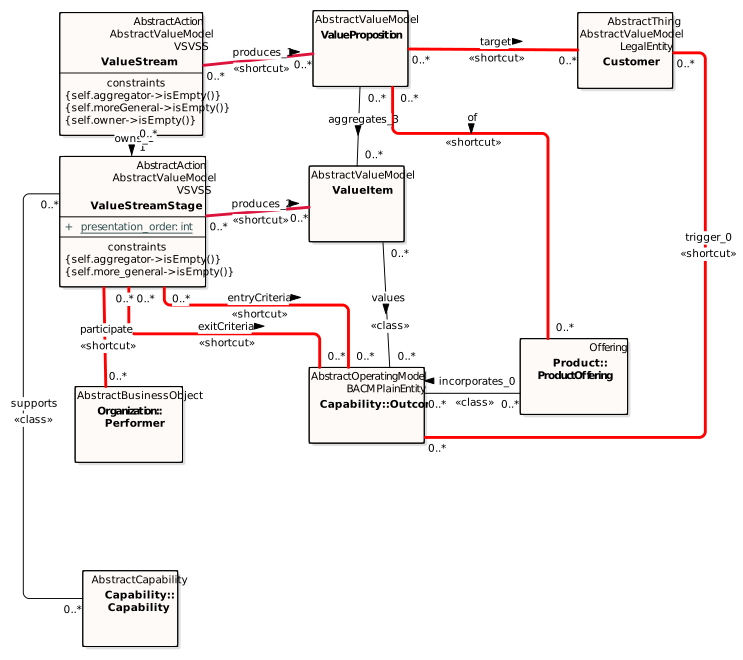
    Abstract elements are not allowed to be instantiated. The MOF metamodel for BACM marks such elements as "abstract" but this information is not carried over to the Owl ontology, leading users to think that it is proper to "instance" (specialize) elements that should not be specialized directly; instead one of the concrete subclasses of the element should be used.

  • Reported: BACM 1.1b1 — Tue, 17 Jun 2025 03:47 GMT
  • Disposition: Resolved — BACM 1.2b1
  • Disposition Summary:

    Add bacm_model:abstract owl:AnnotationProperty

    Change BACMMOF2OWL.py make_class to determine if the isAbstract element is present with a value true. If so, generate an annotation property assertion in the class of bacm_model:abstract true . otherwise generate bacm_model:abstract false.

  • Updated: Thu, 17 Sep 2026 01:13 GMT
Owl ontology is missing required descriptive elements

  • Key: BACM12-11
  • Status: closed  
  • Source: Thematix Partners LLC ( Mr. James Rhyne)
  • Summary:

    See RegulatoryAgencies ontology in commons for examples.

  • Reported: BACM 1.1b1 — Wed, 4 Jun 2025 05:25 GMT
  • Disposition: Resolved — BACM 1.2b1
  • Disposition Summary:

    Make changes to the software that generates the TTL file

    Add code to the software that generates the TTL file to generate equivalent TTL sentence for the BACM 1.2 metamodel.

  • Updated: Thu, 17 Sep 2026 01:13 GMT
Define an annotation property to capture the meta relation in models

  • Key: BACM12-14
  • Status: closed  
  • Source: Thematix Partners LLC ( Mr. James Rhyne)
  • Summary:

    In MOF, the instance association represents the relation between a meta-entity and its model instances. BACM allows model instances to be classes and associations, effectively making an instance a specialization of the meta-entity. BACM also allows the modeler to create specialization relations between model elements.
    To support the metamodeling notion in OWL-based tools, it is necessary to be able to distinguish specialization created by the modeler from meta-entity specialization that is created by the tool, e.g. when creating a model instance of the meta-class "Capability". The instancing process in a tool can be complex. For example, instancing a BACMBinDirRelation such as "expects_o" requires the creation of a subclass of "expects_0" (and noting that it is a meta-class relation), and creating two ObjectProperties that are sub-ObjectProperties of "expects_0.to_expects_0" and "expects_0.from_expects_0". The tool should prevent the modeler from changing any of the these specialization relations or to deleting any of the created elements. The tool should only allow the modeler to delete the entire instance or to add axioms and assertions that do not change the semantics of the instance with respect to its meta-entity. Consequently, the tool must be aware of these specializations.

  • Reported: BACM 1.1b1 — Wed, 25 Jun 2025 17:00 GMT
  • Disposition: Resolved — BACM 1.2b1
  • Disposition Summary:

    Define an annotation property to link an element to its meta-element

    Specifically, define http://www.omg.org/spec/BACM/20230501/BACM_Model/meta as an owl:AnnotationProperty in the default definitions for the metamodel. Tool makers are advised to make the IRI definition available by generating an import BACM statement in any model using the BACM as a metamodel. Tool makers are also advised to generate both this annotation property and a subclass/subproperty statement when creating a model element from a metamodel element.

  • Updated: Thu, 17 Sep 2026 01:13 GMT
Missing specialization relationships

  • Key: BACM12-10
  • Status: closed  
  • Source: Thematix Partners LLC ( Mr. James Rhyne)
  • Summary:

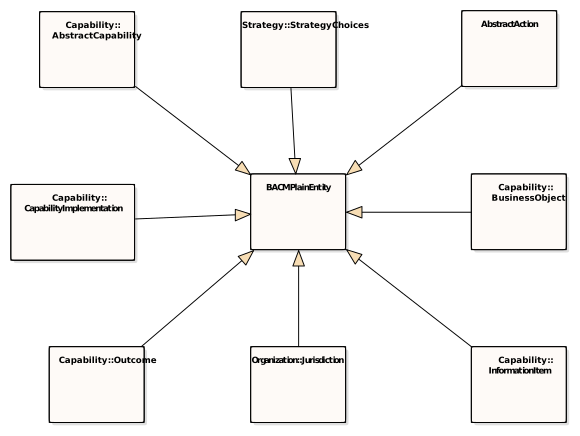
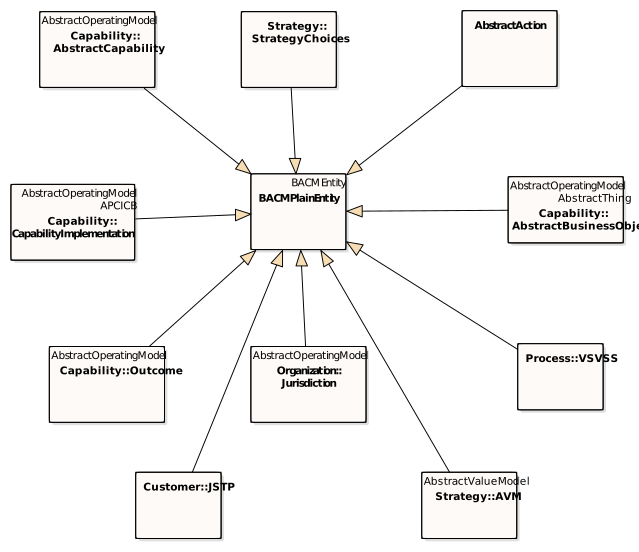
    The following classes should specialize BACMPlainEntity but do not:
    'bacm_cap:AbstractBusinessObject',
    'bacm_cust:Customer',
    'bacm_cust:ValueItem',
    'bacm_org:OrgUnit',
    'bacm_cust:JSTP',
    'bacm_org:LegalEntity',
    'bacm_cust:ValueProposition',
    'bacm_cust:CustomerSegment',
    'bacm_org:Performer',
    'bacm_prod:APCICB',
    'bacm_model:AbstractThing',
    'bacm_proc:VSVSS',
    'bacm_org:System'

  • Reported: BACM 1.1b1 — Thu, 29 May 2025 00:33 GMT
  • Disposition: Resolved — BACM 1.2b1
  • Disposition Summary:

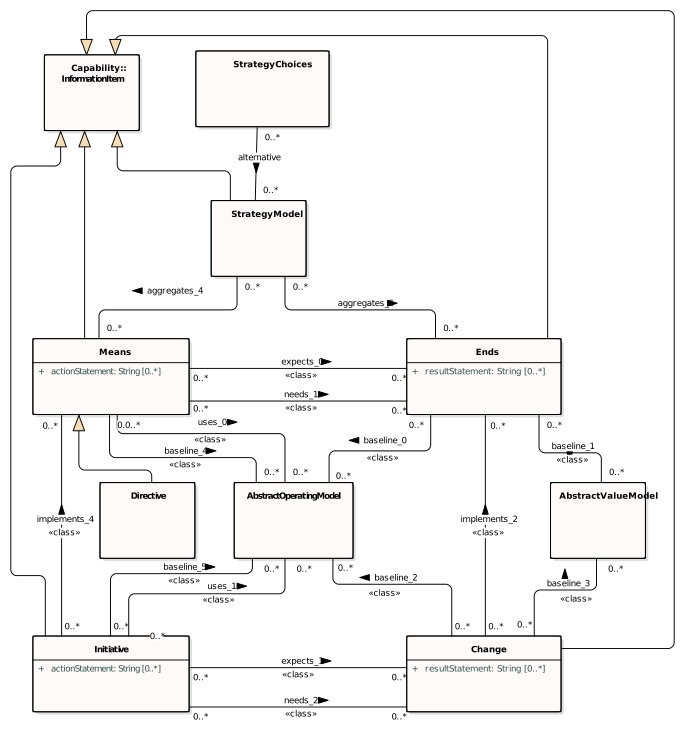
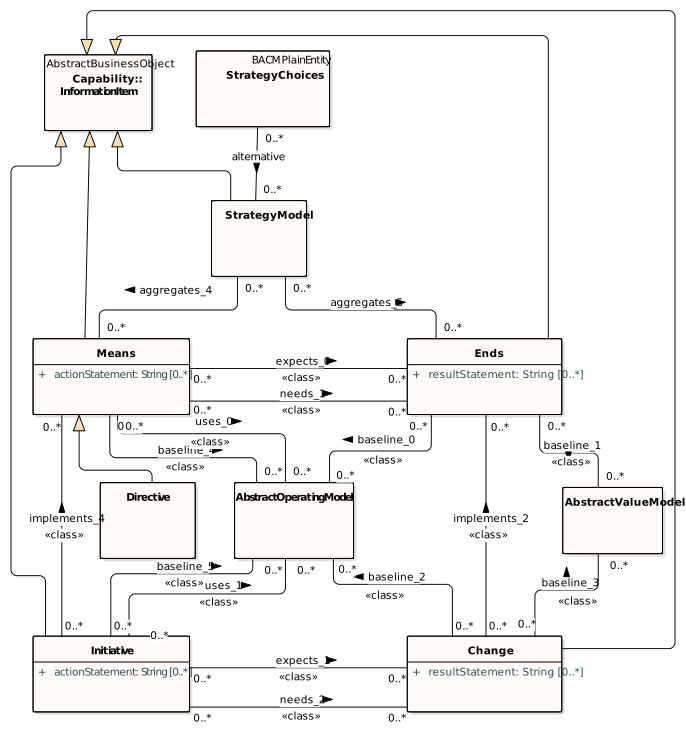
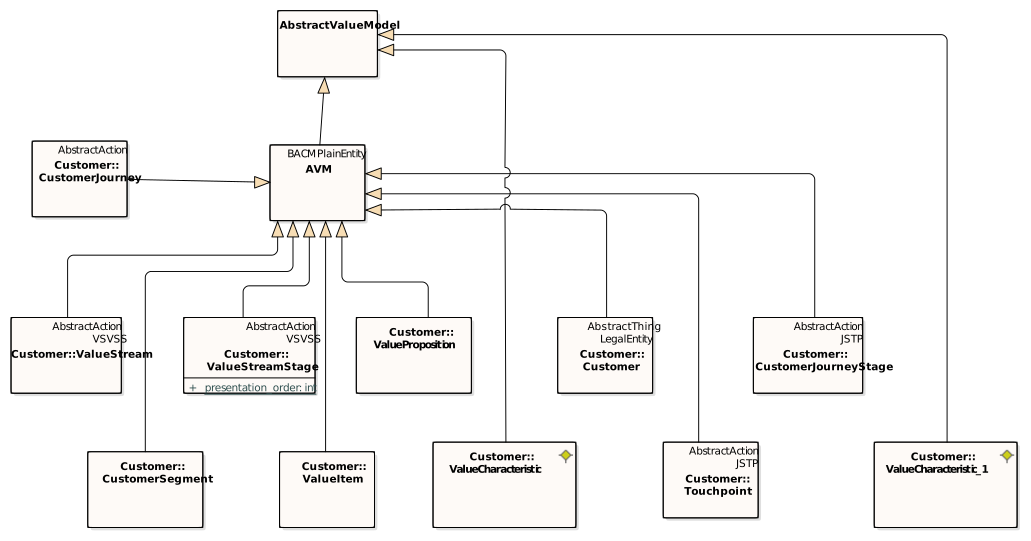
    Change BACM_Entities diagram and correct other diagrams

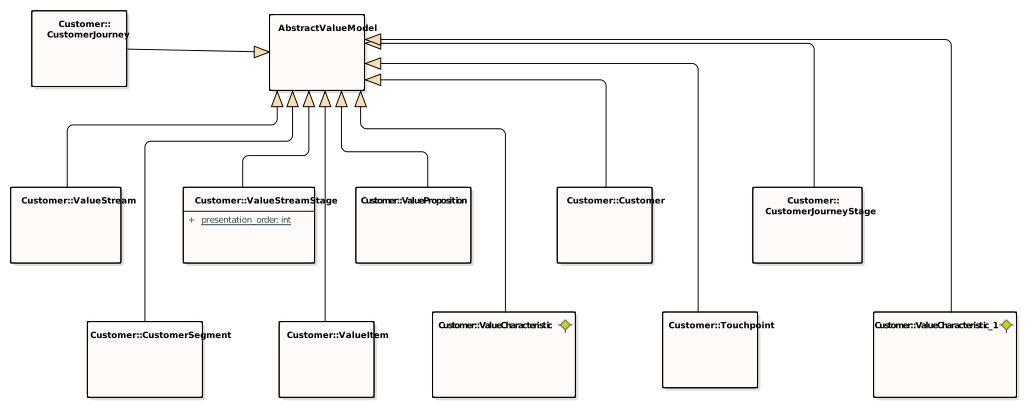
    In ValueModel:
    Rename AbstractValueModel to AVM
    Add new class named AbstractValueModel
    Move the notes from AVM to AbstractValueModel
    Add the following note to AVM:
    Definition: AVM is an abstract superclass whose purpose is to complete the specialization hierarchy and to simplify the BACM_Entities diagram.
    AbstractValueModel generalizes AVM
    Change ValueCharacteristic generalization from AVM to AbstractValueModel
    Change ValueCharacteristic_1 generalization from AVM to AbstractValueModel

    In Strategy:
    Add AbstractValueModel to diagram
    Change baseline_1 association from AVM to AbstractValueModel
    Change baseline_3 assocation from AVM to AbstractValueModel
    Delete AVM from the diagram
    Make AbstractValueModel abstract

    In BACM_Entities:
    Add AVM generalized by BACMPlainEntity
    Add JSTP generalized by BACMPlainEntity
    Add VSVSS generalized by BACMPlainEntity
    Remove BACMPlainEntity generalizes BusinessObject
    Add AbstractBusinessObject, generalized by BACMPlainEntity
    Remove BACMPlainEntity generalizes InformationItem
    Remove InformationItem

  • Updated: Thu, 17 Sep 2026 01:13 GMT
  • Attachments:

Owl ontology incorrect restriction definitions

  • Key: BACM12-8
  • Status: closed  
  • Source: Thematix Partners LLC ( Mr. James Rhyne)
  • Summary:

    The translation of the MOF model to OWL is generating owl:onClass statements when the restriction quantification assertion does not require them, Some ontology editors and classifiers will ignore these statements, but not all.

  • Reported: BACM 1.1b1 — Tue, 29 Apr 2025 21:34 GMT
  • Disposition: Resolved — BACM 1.2b1
  • Disposition Summary:

    Corrent BACMMOF2OWL.py to generate proper statements

    The code in BACMMOF2OWL.py to generate OPRs and DPRs did not distinguish when a class restriction was present and generate the proper predicates for the quantification statement. The program logic should be changed to distinguish when a class restriction is present and use the appropriate quanitification predicates.
    Changes made and tested

  • Updated: Thu, 17 Sep 2026 01:13 GMT
UML datatype PrimitiveTypes.xmi#Integer not translated into TTL

  • Key: BACM12-26
  • Status: closed  
  • Source: Thematix Partners LLC ( Mr. James Rhyne)
  • Summary:

    The software rule to translate this UML XMI datatype specification was omitted from the primitive types translation dict in BACMMOF2OWL.py

  • Reported: BACM 1.1b1 — Mon, 27 Oct 2025 16:28 GMT
  • Disposition: Resolved — BACM 1.2b1
  • Disposition Summary:

    Add a trule to translate this UML type

    Add a rule to translate 'http://www.omg.org/spec/UML/20131001/PrimitiveTypes.xmi#Integer' to 'xsd:integer'.

  • Updated: Thu, 17 Sep 2026 01:13 GMT
Translation of owns associations to TTL

  • Key: BACM12-15
  • Status: closed  
  • Source: Thematix Partners LLC ( Mr. James Rhyne)
  • Summary:

    The translation of MOF XMI to TTL incorrectly assigns ownership of the owns_4 association to ValueCharacteristic as ValueCharacteristic.owns_4. The translation program uses a heuristic - if an association is sourced at a class that is a subclass of BACMRelation, it is treated as a leg of that class and given a name that is <class_name>.<association_name>. Associations named "owns", "aggregates" or "generalizes" should be excluded from this heuristic as they have fixed semantics (composition, aggregation, specialization) that are not conditioned by the relationship class semantics. Thus has appeared in the TTL as "ValueCharacteristic.owns_4", which should be named "owns_4".
    This change does not affect the specification document, the EA model or the MOF XMI.

  • Reported: BACM 1.1b1 — Mon, 14 Jul 2025 15:55 GMT
  • Disposition: Resolved — BACM 1.2b1
  • Disposition Summary:

    Add a test in make_qname to correct this

    Add test to make_qname to not prefix the source class name to an association of the name of the unstereotyped association contains 'owns'. The owns_4 association is a unique case because the association is represented in the UML as an association stereotyped class, and the source qualification rules would apply, except that owns is a special association used in the UML to indicate that the existence of the target is dependent on the existence of the source.

  • Updated: Thu, 17 Sep 2026 01:13 GMT
Define JSON interchange specification

  • Key: BACM12-2
  • Status: closed  
  • Source: Thematix Partners LLC ( Mr. James Rhyne)
  • Summary:

    JSON is an increasingly popular serialization format. JSON-LD provides some key additional capabilities.

  • Reported: BACM 1.0b2 — Tue, 28 Nov 2023 22:35 GMT
  • Disposition: Deferred — BACM 1.2b1
  • Disposition Summary:

    Lack of time and resources to create a proposal

    This is a major task but other tasks with higher priority have delayed this one. It does not appear that there will be time or resources to submit a meaningful proposal.

  • Updated: Thu, 17 Sep 2026 01:13 GMT
Owl Ontology incorrect restrictions - onDataRange

  • Key: BACM12-9
  • Status: closed  
  • Source: Thematix Partners LLC ( Mr. James Rhyne)
  • Summary:

    The translation of the MOF metamodel into OWL is generating owl:onDataRange statements when the restriction type is not qualified. Many tools will ignore this error, but some will not.

  • Reported: BACM 1.1b1 — Fri, 2 May 2025 16:38 GMT
  • Disposition: Duplicate or Merged — BACM 1.2b1
  • Disposition Summary:

    Merged with BACM12-8

    This proposal is merged with BACM12-8 which also fixes the issue fixed by this proposal.

  • Updated: Thu, 17 Sep 2026 01:13 GMT

Annotation axioms missing from OWL ontology

  • Key: BACM12-12
  • Status: closed  
  • Source: Thematix Partners LLC ( Mr. James Rhyne)
  • Summary:

    LegalEntity has an ownedComment in the XMI that should have resulted in annotation axioms in the RDF Turtle, but the annotation axioms are not in the generated .ttl file.

  • Reported: BACM 1.1b1 — Tue, 10 Jun 2025 19:51 GMT
  • Disposition: Resolved — BACM 1.2b1
  • Disposition Summary:

    Fix bug in BACMMOF2OWL.py parse_comment function

    A logic mistake in the parse_comment function was failing to generate the skos:definition statement except when a usage note was also present in the ownedComment body.

  • Updated: Thu, 17 Sep 2026 01:13 GMT

No relationship between ProductOffering and Customer

  • Key: BACM12-5
  • Status: closed  
  • Source: Thematix Partners LLC ( Mr. James Rhyne)
  • Summary:

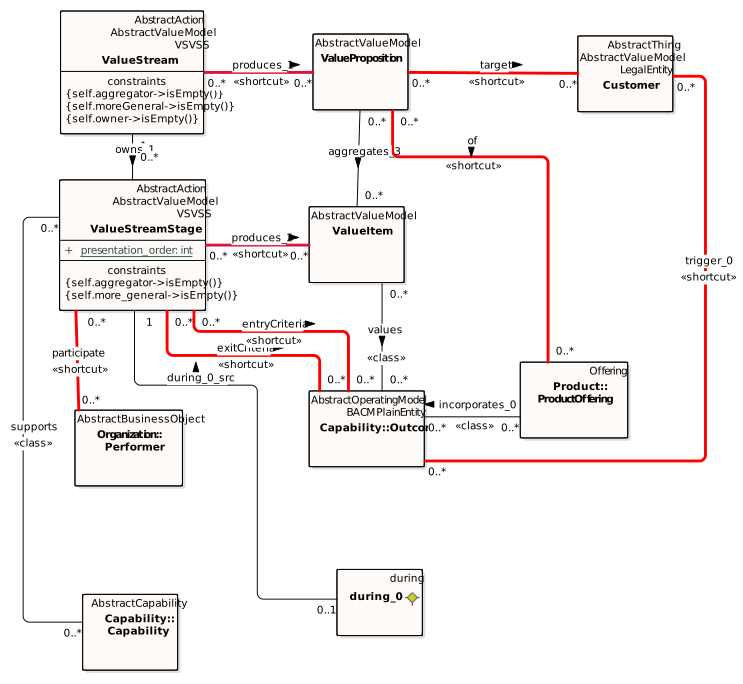
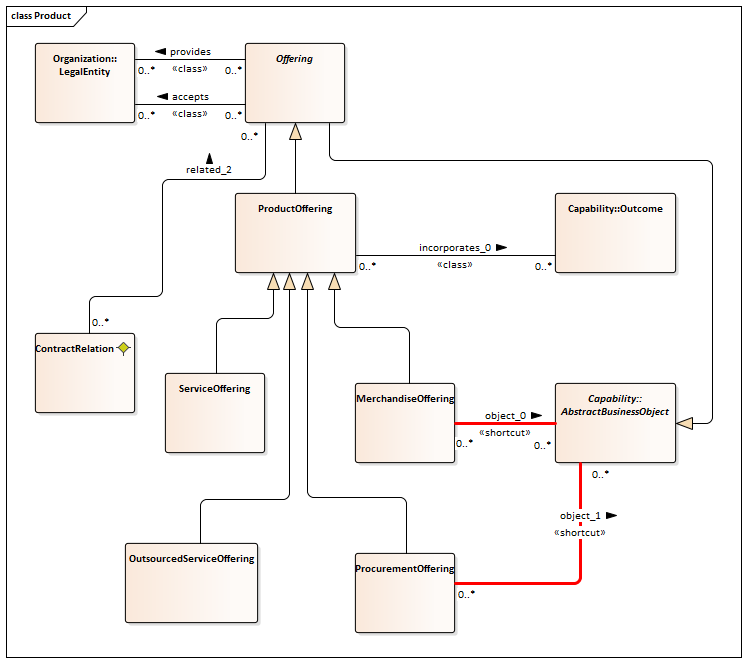
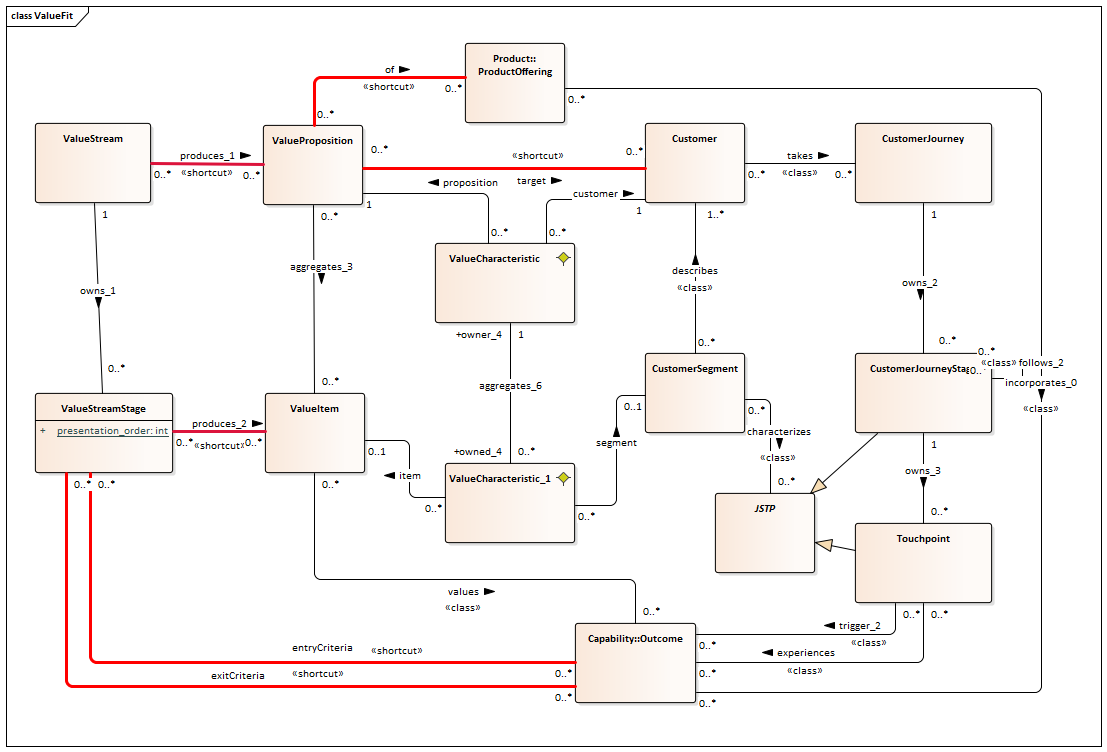
    The ability to associate products with customers is important. In the current metamodel, this connection can only be made by joining a customer targeted by a value proposition with a product offering where the value proposition is of the product offering. Should the metamodel include a direct relationship between product offering and customer? Should this relationship be a shortcut?

  • Reported: BACM 1.0b2 — Wed, 5 Jun 2024 16:47 GMT
  • Disposition: Deferred — BACM 1.2b1
  • Disposition Summary:

    Need to augment the path language

    The conditions required by this issue are not expressible in the current path language. Assume targets_1 is a shortcut relation from ProductOffering to Customer. A potential shortcut path would be:
    targets_1.Customer.customer.ValueCharacteristic.proposition.ValueProposition.aggregates_3.ValueItem.values.Outcome.^incorporates.ProductOffering.targets_1. However, this lacks the additional requirement that the Customer and the LegalEntity that is the acceptor of the ProductOffering be the same. It is not clear how to augment the path language to specify this constraint, which can be expressed in both OCL and in SPARQL.

  • Updated: Thu, 17 Sep 2026 01:13 GMT
  • Attachments:

Binding object

  • Key: BACM12-4
  • Status: closed  
  • Source: Thematix Partners LLC ( Mr. James Rhyne)
  • Summary:

    The BIZBOK introduces the notion that value streams include the concept of a binding business object(s) whose state, together with entry and exit criteria controls the sequencing of value stream stages. How should BACM represent this concept? Is it explicit in the metamodel, or is it the result of analysis or some combination of these?

  • Reported: BACM 1.0b2 — Fri, 3 May 2024 18:36 GMT
  • Disposition: Deferred — BACM 1.2b1
  • Disposition Summary:

    No consensus solution was reached

    The current version of the BIZBOK describes the binding business object, but does not provide a way to identify it that can be expressed as a configuration of BACM metamodel elements. Consequently, the issue is deferred pending new guidance. The business architect who wishes to use this concept can annotate any business object as a binding business object of a value stream

  • Updated: Thu, 17 Sep 2026 01:13 GMT

Reconsider the packaging and namespace conventions

  • Key: BACM12-1
  • Status: closed  
  • Source: Thematix Partners LLC ( Mr. James Rhyne)
  • Summary:

    The justification for namespaces is to permit parts of the model to be used independently. The current packaging is close, but crossmaps between value stream and capability are defined in Capability and crossmaps between ValueItem and Outcome are defined in Customer. Customer mixes together Journeys and Value Streams. Consider repackaging to eliminate crossmaps from the core packages and add new packages with just the crossmaps. This would also benefit use of the OWL as a group of ontologies instead of one large one.

  • Reported: BACM 1.0b2 — Tue, 28 Nov 2023 22:21 GMT
  • Disposition: Deferred — BACM 1.2b1
  • Disposition Summary:

    Lack of time and resources to create a proposal

    Other issues were judged to be more important than this one. There does not appear to be either time or resources to create a meaningful proposal prior to the end of the RTF.

  • Updated: Thu, 17 Sep 2026 01:13 GMT