1. OMG Mailing List
  2. Business Architecture Core Metamodel 1.2 Revision Task Force

Open Issues

  • Issues not resolved
  • Name: bacm-rtf
  • Issues Count: 9

Issues Descriptions

Semantics of reified relations should be aggregation

  • Key: BACM12-36
  • Status: open  
  • Source: Thematix Partners LLC ( Mr. James Rhyne)
  • Summary:

    The BACM 1.1b1 document does not explicitly state that the semantics of all reified relations is aggregation, leading to a possible interpretation of these relationships as ownership or specialization. The BACM 1.1b1 document explicitly provides simple relations of specialization, composition and aggregation. All simple associations and all stereotyped associations should be interpreted as aggregations only.

  • Reported: BACM 1.1b1 — Thu, 15 Jan 2026 19:13 GMT
  • Updated: Thu, 12 Feb 2026 17:22 GMT

Change sections 7.2.1.6 and 7.2.3 to remove individual stereotype

  • Key: BACM12-39
  • Status: open  
  • Source: Thematix Partners LLC ( Mr. James Rhyne)
  • Summary:

    The 1.1b1 model no longer has theBusiness as an <<individual>> stereotyped class, and the <<individual>> stereotype has been removed. All classes now represent sets of individuals.

  • Reported: BACM 1.1b1 — Thu, 15 Jan 2026 19:51 GMT
  • Updated: Thu, 12 Feb 2026 17:22 GMT

Clarify that reified relations such as OutcomeRelation are aggregations

  • Key: BACM12-35
  • Status: open  
  • Source: Thematix Partners LLC ( Mr. James Rhyne)
  • Summary:

    The 1.1 documentation does not specify that semantics of specialization or ownership do not apply to reified relations. This can be resolved by altering the description of BACMRelation to state that the semantics prohibit a semantic interpretation of composition or a semantic interpretation of specialization.

  • Reported: BACM 1.1b1 — Thu, 15 Jan 2026 18:53 GMT
  • Updated: Thu, 12 Feb 2026 17:22 GMT

Consider adding logical relations for combining Outcomes

  • Key: BACM12-6
  • Status: open  
  • Source: Thematix Partners LLC ( Mr. James Rhyne)
  • Summary:

    The current draft provides OutcomeRelation as a template for the model level definition of relations between outcomes. Recent work on entry and exit criteria for value streams as well as capability and process flows has informally used logical relationships that instance/specialie OutcomeRelation and effectively define an Outcome that is the logical union or other Outcomes. The issue is whether the metamodel should define a set of specifically logical relations. For example include, exclude, include complement could be used to create an Outcome by conjunctive composition where the semantics of the Outcome is the union of all facts from included Outcomes, no facts from excluded Outcomes (i.e.not known whether these are true or false), complement facts from included complement Outcomes. This is just an example; specific proposal to be worked out.

  • Reported: BACM 1.0b2 — Mon, 19 Aug 2024 16:46 GMT
  • Updated: Sun, 8 Feb 2026 22:21 GMT

Binding object


No relationship between ProductOffering and Customer

  • Key: BACM12-5
  • Status: open  
  • Source: Thematix Partners LLC ( Mr. James Rhyne)
  • Summary:

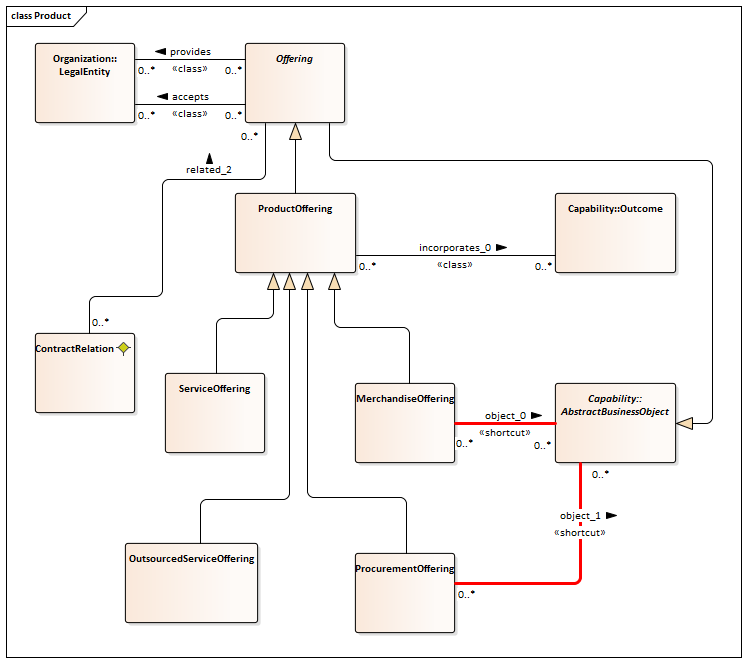
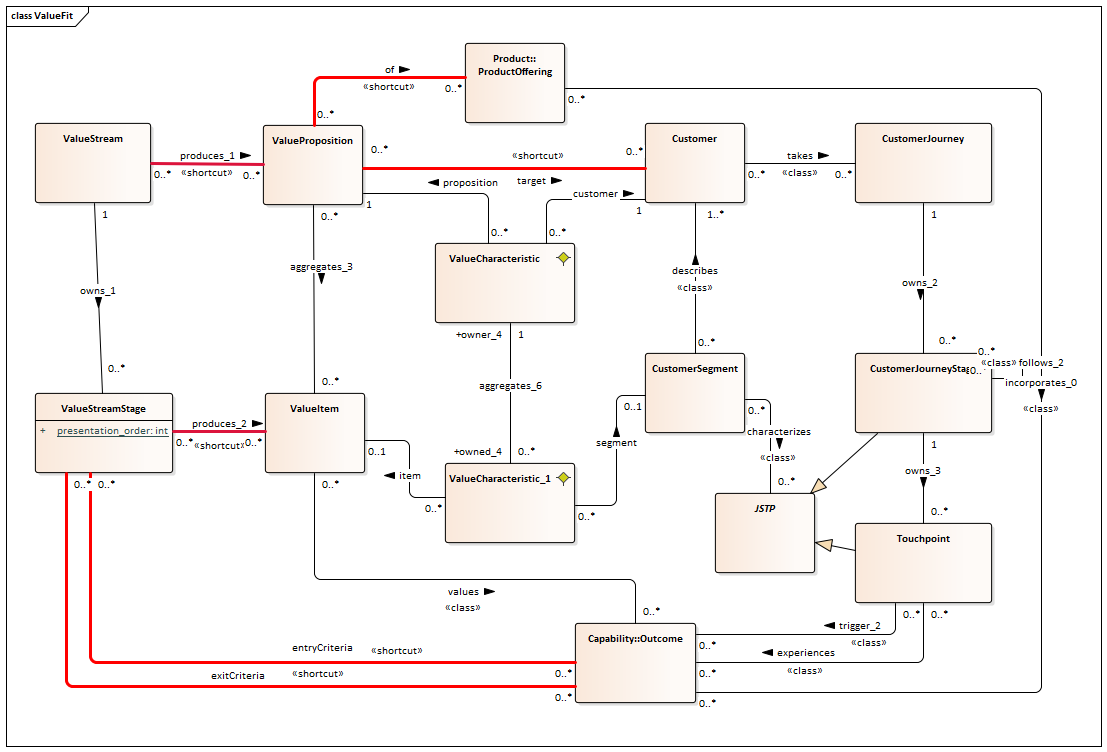
    The ability to associate products with customers is important. In the current metamodel, this connection can only be made by joining a customer targeted by a value proposition with a product offering where the value proposition is of the product offering. Should the metamodel include a direct relationship between product offering and customer? Should this relationship be a shortcut?

  • Reported: BACM 1.0b2 — Wed, 5 Jun 2024 16:47 GMT
  • Updated: Sun, 8 Feb 2026 22:21 GMT
  • Attachments:

Operating Value Streams

  • Key: BACM12-3
  • Status: open  
  • Source: Thematix Partners LLC ( Mr. James Rhyne)
  • Summary:

    Some organizations have developed what they call operating value streams. Sometimes these arise from application of "Lean" methdology. But, they may also arise from a desire to model the creation of value associated with particular product lines and analyze those representations of value with respect to the generic models of value creation provided by value streams.
    Specialization of value streams and stages is disallowed by the BIZBOK (to avoid the common methodological mistake of conflating value streams and processes). Is there a need for operating value streams? Is there a way to represent this that does not violate the BIZBOK?

  • Reported: BACM 1.0b2 — Thu, 7 Mar 2024 18:11 GMT
  • Updated: Sat, 20 Dec 2025 00:40 GMT

Define JSON interchange specification

  • Key: BACM12-2
  • Status: open  
  • Source: Thematix Partners LLC ( Mr. James Rhyne)
  • Summary:

    JSON is an increasingly popular serialization format. JSON-LD provides some key additional capabilities.

  • Reported: BACM 1.0b2 — Tue, 28 Nov 2023 22:35 GMT
  • Updated: Sat, 20 Dec 2025 00:40 GMT

Reconsider the packaging and namespace conventions

  • Key: BACM12-1
  • Status: open  
  • Source: Thematix Partners LLC ( Mr. James Rhyne)
  • Summary:

    The justification for namespaces is to permit parts of the model to be used independently. The current packaging is close, but crossmaps between value stream and capability are defined in Capability and crossmaps between ValueItem and Outcome are defined in Customer. Customer mixes together Journeys and Value Streams. Consider repackaging to eliminate crossmaps from the core packages and add new packages with just the crossmaps. This would also benefit use of the OWL as a group of ontologies instead of one large one.

  • Reported: BACM 1.0b2 — Tue, 28 Nov 2023 22:21 GMT
  • Updated: Sat, 20 Dec 2025 00:40 GMT